


We are all familiar with New York, it is the backdrop and landscape to many of our favourite television shows, movies and music videos, this was never made clearer to me than as I rode the train from Newark, New Jersey to Central Station, New York.
The panarama of familiar buildings and landscapes as the train arched around the city to snake into Central Station had my face pressed up against the window childlike in awe, I challenge anyone not to be impressed by the city unfolding in front of you from that moving train window. The train brought me into Penn station which is in Midtown area of Manhattan and sits beneath Madison Square Garden, between Seventh Avenue and Eighth Avenue and between 31st and 34 street on New York’s street grid system.
New York:
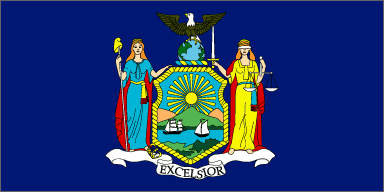
New York City traces its origin to its 1624 founding in Lower Manhattan as a trading post by colonists of the Dutch Republic and was named New Amsterdam in 1626, however the city and its surroundings came under English control in 1664 and were renamed New York after King Charles II of England granted the lands to his brother, the Duke of York. New York then served as the capital of the United States from 1785 until 1790. It has been the country’s largest city since 1790.
The City of New York, or simply New York, is the most populated city in the United States, with a population of around 8.5 million. Situated on one of the world’s largest natural harbors, New York City consists of five boroughs, each of which is a separate county of New York State. These five boroughs – Brooklyn, Queens, Manhattan, The Bronx, and Staten Island were consolidated into a single city in 1898.
New York has historically been the central gateway for legal immigration to the United States,and as many as 800 languages are spoken in New York, making it the most linguistically diverse city in the world. New York City is home to more than 3.2 million residents born outside the United States which is the world’s largest foreign-born population of any American city.
With New York being an extremely expensive city to visit with Hotel prices regularly in the region of $250 -$350 per night, as I would be based there for around 5 nights I sought out alternative accommodation and used a relatively new social media app (well its new for me!) called Airbnb.
Airbnb is an online marketplace enabling people to lease or rent for the short term including apartments, hotel, hostel and homestays. By using this I was able to select a suitable apartment in Hells Kitchen for my whole stay at a cost comparable to just over one nights standard hotel charge.

This was a major change to my previous travel experiences since my younger backpacking days of the early 1990’s and I spent fantastic 5 days in New York, in my own private room of a Hell’s Kitchen apartment leased to me by two New Yorkers!
Hell’s Kitchen:


I based myself in the Midtown district of Clinton better known as Hell’s Kitchen, Once an enclave of poor and working class Irish immigrants and later to generations who would classify themselves as Irish-Americans. However similar to South Boston the area has been subject to gentrification and development pressures have driven many people of modest means from the district in the last 25-30 years.
There are many stories as to how Clinton came by the nickname Hell’s Kitchen, it first appeared in print on September 22, 1881 when a New York Times reporter went to the area with a police guide to get details of a multiple murder there. He referred to the enclave in his newspaper article as “Hell’s Kitchen,” and said that the entire section was “probably the lowest and filthiest in the city.”
Another and the most common version traces it to the story of “Dutch Fred the Cop,” a veteran policeman, who with his rookie partner, was watching a small riot on West 39th Street. The rookie is supposed to have said, “This place is hell itself,” to which Fred replied, “Hell’s a mild climate. This is Hell’s Kitchen.
The Irish Diaspora:
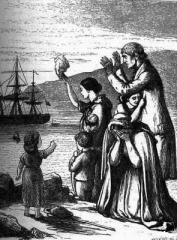
“Hell’s Kitchen” in New York and “Southie” in Boston both were areas the Irish diaspora settled in when arriving in their millions from Ireland in the 19th century and onwards. As I grew up stories of family members in both cities would filter home and news of other family members at first visiting and then staying in these areas was commonplace. The Irish diaspora to America have been immortalised in the words of many songs including the famous Irish ballad “The Green Fields of America”:
- “So pack up your sea-stores, consider no longer,
- Ten dollars a week is not very bad pay,
- With no taxes or tithes to devour up your wages,”
https://en.wikipedia.org/wiki/Irish_diaspora
As some of my family members prospered they moved out of Hell’s Kitchen to Brooklyn, however many stayed in Hell’s Kitchen to remain close to family and their cultural links. Brooklyn Bridge was often a link between the two communities, (Manhattan and Brooklyn) and as such one Sunday morning I rose early with the plan to follow in these footsteps.
Brooklyn Bridge -The walk from Brooklyn through Chinatown and Little Italy:


I arrived into New York City late Saturday night and after settling into my apartment the following morning I was up early and took the subway (redline train No 2) to Brooklyn with the intention to walk across the Brooklyn Bridge and visit various cultural and historical districts including some other famous New York immigrant enclaves such as Chinatown and Little Italy on my way back to Hell’s Kitchen.
As the subway rattles into Brooklyn you leave the city behind you, so when you walk across the Brooklyn Bridge back into Manhattan the New York city skyline is in front of you. The Brooklyn Bridge is one of the oldest bridges in the United States. opening in 1883 and is now an icon of New York City and was designated an American National Historical Landmark in 1964.
I grabbed some breakfast from a ‘hole in the wall’ in the district of DUMBO (Down under the Manhattan Bridge overpass) and began my walk across Brooklyn Bridge. The Bridge spans the East River which even on a crisp bright Sunday morning offered walkers a bracing wind to contend with, walking the Bridge took me around 30 to 40 minutes with fantastic views of the city.


Once across the bridge I immediately found myself in Chinatown, this is in my opinion the exciting element of exploring New York, around any corner is a part of the city that makes you feel you have entered another culture, another country even.
Chinatown is about 2 miles in total area and home to around 150,000 residents, historically the neighbourhood has been an enclave to Chinese, Irish and German immigrants and freed slaves since the early 1800’s. In more modern times the area has become home to both ‘established immigrants’ from Canton Province and ‘new immigrants’ from Fujian Province, China.
Following Canal Street I found myself in tight narrow streets, with strange and excotic goods for sale on the sidewalks, businesses, street signs and radios all assaulted my senses, with local residents proudly reflecting thier cultural identity. I spent a wonderful hour wandering through exploring and enjoying the district.


The magic of New York means as you come to the end of one street and cross over to the other sidewalk you enter another historic immigrant enclave.
Little Italy
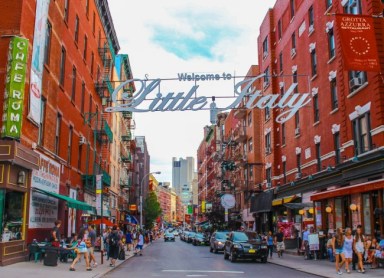
Little Italy originated due to the mass migration of Italians to America in the 1880’s who once arrived settled in lower Manhattan and in East Harlem (known as Italian Harlem). The New York magazine wrote describing Little Italy “as like an insular Neapolitan village re-created on these shores, with its own language, customs, and financial and cultural institutions.”
By 1910 Little Italy had almost 10,000 Italians residents which was to be the peak of the community’s Italian population with over 90% of the residents of the district were of Italian birth. However By around World War II, many residents of the Lower East Side began moving to Brooklyn, Staten Island, Long Island, and New Jersey.
The Little Italy enclave like some many other historical immigrant neighbourhoods has in recent times felt the impact of gentrification The New York magazine on this topic said “Real-estate prices have zoomed in this area making it even tougher for the old-timers, residents and businesspeople alike to hang on.”
As I walked through the remaining streets of Little Italy which on both sides of the street were occupied by Italian restaurants or souvenir shops I felt a feeling of overwhelming disappointment, unlike Chinatown which feels like a vibrant bustling and modern hub of Chinese American society this historical Italian neighbourhood seems a parody of itself and is more a tourist landmark than a reflection of the cultural links this area had with Italian immigration into America.
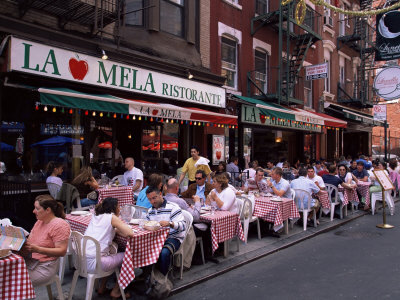
There was no alternative I turned on my heels walked back across the street returning into Chinatown and had quite simply the best Chinese food I have ever tasted for my lunch.
Ground Zero/One World Trade Centre:
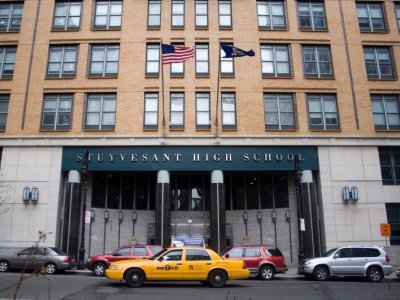
After my Sunday exploring various historical immigrant enclaves I spent the following day visiting Ground Zero and One World Trade Centre. I had arranged with Stuyvesant High School to participate in their educational visit to Ground Zero/One World Trade Centre with 75 of their students from their Government/politics course and another 23 students on various history and civic student programs. As such after meeting the staff faculty and students we travelled to the World Trade Centre by subway.
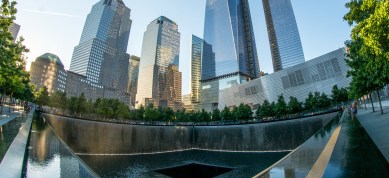
I was advised that this visit was to support students to be able to discuss the events of September 11, 2001 through the use of primary sources and be able to analyse and interpret what they absorb from the wider media and their peers, as children born around or after 2001, 9/11 can be an abstract concept, a tragedy that happened in history but not applicable to their lives simply because it is too large to process.
Students were respectful and responsive to the various exhibits and information provided and what was fascinating was the response to the ‘Survivor Tree” which sits proudly in the centre of the complex and seemed a focal point and rallying point for visitor’s. 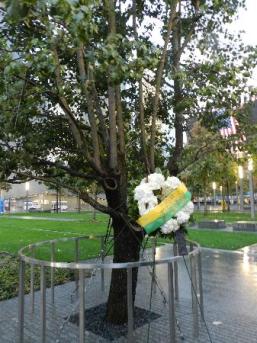
I was however troubled that this important cultural and historical landmark is a paid attraction with rather high entrance fees of $24 for adults and $15 for children and that will having an entrance fee actually deter schools and families visiting and having access to this incredibly important story. Whilst there’s no admission for the memorial, only the museum element, 9/11 is similar to today’s high school students as the Vietnam War was to children from that generation, in as much students know it existed but little else and memorials, museum’s and cultural landmarks are important in meeting that knowledge gap.
Staff from Stuyvesant High School also recommended I visit the Immigration Museum on Ellis Island which forms further SMSC educational visits students undertake, as such on my final day in New York I rode the subway to Battery Park to catch the ferry over to Ellis Island.
Ellis Island and The Statue of Liberty:


American Immigration:
Modern America has been built on immigration, the history of American immigration can be seen in four distinct periods: the colonial period, the mid-19th century, the start of the 20th century, and post-1965.
By the 1600’s the first explorers such as Christopher Columbus were followed by settlers and the immigration to America by Europeans had began, other immigrants from European countries such as the Netherlands and the Scandinavian countries followed as American colonies were seen as an extension of the European homelands. During the 17th century, approximately 400,000 English people migrated to Colonial America with over half of all the European immigrants arriving during the 17th and 18th centuries being indentured servants.
The mid-19th century saw mainly an influx from northern Europe; the early 20th-century mainly from Southern and Eastern Europe with people fleeing war, religious persecution and seeking economic opportunities and a better standard of living, as these immigrants arrived they needed to be screened, health checked and processed into the country.
Ellis Island:


In the 35 years before Ellis Island opened, more than eight million immigrants arriving in New York City were processed at Castle Garden Immigration Depot in Lower Manhattan, when Ellis Island opened it became the main gateway for a further 12 million immigrants into the United States and served as the nation’s busiest immigrant inspection station for over sixty years from 1892 until 1954.
Between 1905 and 1914, an average of one million immigrants per year arrived in the United States with Immigration officials reviewing about 5,000 immigrants per day of which two-thirds of those had emigrated from eastern, southern and central Europe.
Today, over 100 million Americans about one-third or forty percent of the population of the United States can trace their ancestry to the immigrants who first arrived in America at Ellis Island before dispersing to points all over the country.
I spent the morning taking a guided tour around the museum which is wonderful piece of living and evolving American history showing future generations how many immigrants came to America under dire circumstances and were able to establish themselves in the new country.
http://www.emmigration.info/european-immigration-to-america.htm
https://libertyellisfoundation.org/immigration-museum
The Statue of Liberty:


The second part of the day consisted of collecting the sight-seeing ferry for a 2 hour cruise down the East River under the various famous NYC bridges including Brooklyn Bridge, Manhattan Bridge and the Williamsburg Bridge before circling the Statue of Liberty and looking back towards the southern tip of New York City and the World Trade Centre.
The Statue of Liberty is a designated UNESCO World Heritage Site. The UNESCO “Statement of Significance” regarding the statue describes it as “masterpiece of the human spirit” that “endures as a highly potent symbol inspiring contemplation, debate and protest of ideals such as liberty, peace, human rights, abolition of slavery, democracy and opportunity.”.
The noise of tourists and families enjoying the sunshine, taking photographs of the passing tourist sights and being on the water fell to a hush as the ferry approached the Statue, as if we all knew instinctively that we were in the presence of an iconic and hugely important historical landmark that dersevered respect and quiet contemplation. Lady Liberty in all her splendour glistened 305ft above us and she stared out stoically as she has always done so into the face of world events that have occurred since she first watched over New York 1886. A poem called “The New Colossus” written by Emma Lazarus is on the statues base placed there in 1903. The most famous line of the poem is “Give me your tired, your poor, your huddled masses yearning to breathe free.”
It has in the last hundred and 14 years (and will I am sure continue) to represent American immigration policies.

As I watched her approach I felt in some small way connected to the millions of immigrants who came to the United States through New York and their first sight of America was Lady Liberty holding her torch high in the sky in welcome to those arriving reflecting a new beginning based upon hope


It was a magical and emotional experience being in the Lady’s presence just like it was last time I saw her back in 1994, that time I walked the stairs to look out from her crown, as I sat there contemplating my own life journey in those 23 years something happened that could only happen in New York, the ferry sound system burst into Frank Sinatra’s song “New York New York” totally shattering the mood and bringing everyone including myself on the ferry back to 2017.
In all my time in America both on this trip and on previous visits nothing exemplifies America and American values quite like Lady Liberty.
God bless her!
https://www.nps.gov/stli/index.htm
Tom’s Diner & The fairytale of New York:


Sinatra’s song “New York New York” would be the obvious choice when thinking of a song that connects people’s thoughts with that city, however I chosen two more quirky and personal songs.
Partly I chose the first song because of my love of the television show Seinfeld, which used the exterior of the restaurant as the fictional meeting point of four New Yorker’s: Jerry, George, Elaine and Kramer and partly because the lyrics always take me back to that district, Morningside Heights where Tom’s Diner is located whenever I hear the lyrics.
I have been lucky to visit New York on a number of occasions and hope to visit again in the future and whenever I have visited NYC I have spent many an enjoyable hour finding myself like the song “I am waiting, At the counter, For the man, To pour the coffee”…….
The second song I chose because I grew up with this type of music playing around me, and the song whenever I hear it transports me back to Hell’s Kitchen and family members back from America describing New York in the following manner:
“They’ve got cars big as bars
They’ve got rivers of gold
But the wind goes right through you
It’s no place for the old”
Many thanks for visiting my blog and reading the third out of the six reports on the cities I visited on my WHPS.
Please feel free to leave a comment and your thoughts in the comments box at the bottom of this post.
Next Up……………. A bonus blog before I head to my 4th U.S. State and American city this being Washington D.C. & my blog titled “Up on the Hill and down at Foggy Bottom”
In the bonus blog I will look at:
- The American use of qualifiers in cultural identity such as Irish American, Hispanic American, African American etc.
- Is America doing enough to protect its cultural identity which is being eroded by gentrification.
- How the rich and the poor often live cheek by jowl in American cities.
- What impact will the merger of UK teaching unions affect the teaching profession and will it follow the collective unions in America.
 PJR Education Consultancy
It was a great detailed read and particularly provoked thoughts and reflection of the many, many Irish immigrants who walked your New York walk . Looking forwarded to your next stage in Washington DC.
LikeLike
Hello paddy
LikeLike
What a treat to have a Bonus Blog to look forward to before your excursion to Washington!
Will be intrigued to find out about the issues you ”ll be exploring within ” Up the hill and down the Foggy Bottom”
LikeLike