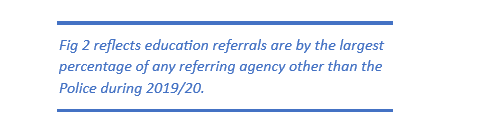
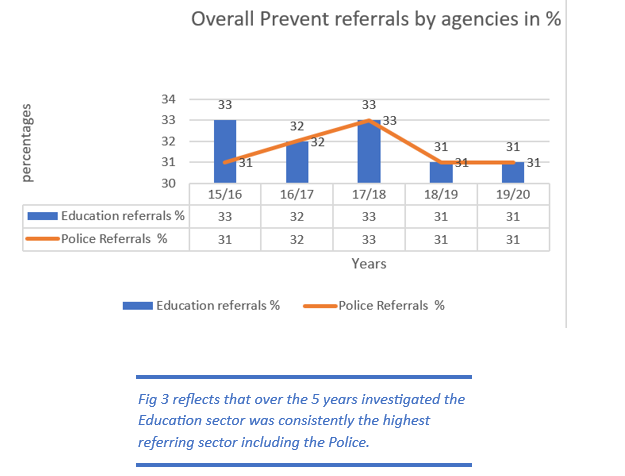
Even when education settings are compared against the Police schools and colleges consistently record the highest referral rates for the period between 2015/16-2019/20.
Fig 3: Prevent referrals comparison Education sector vs. Police 2015-2020
However, it is when exploring the categories for referral from education settings that is most alarming, Prevent was introduced to intervene where people are at risk of radicalisation, including both right wing and Islamist radicalisation, however this is where data reflects specific groups are being targeted based on faith/religious grounds, and by gender and age.
Fig 4: Prevent Referrals by reason. 2015-2020
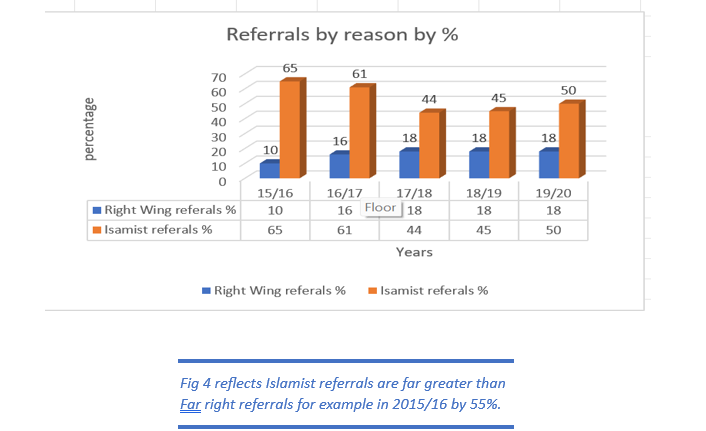
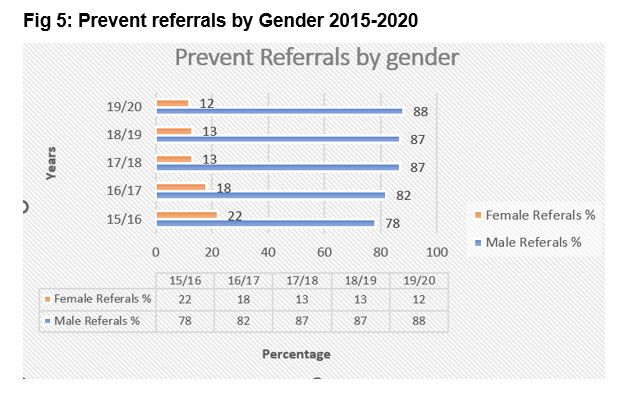
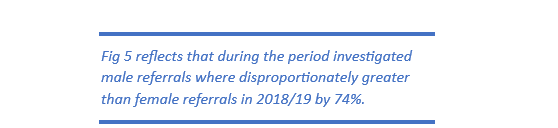
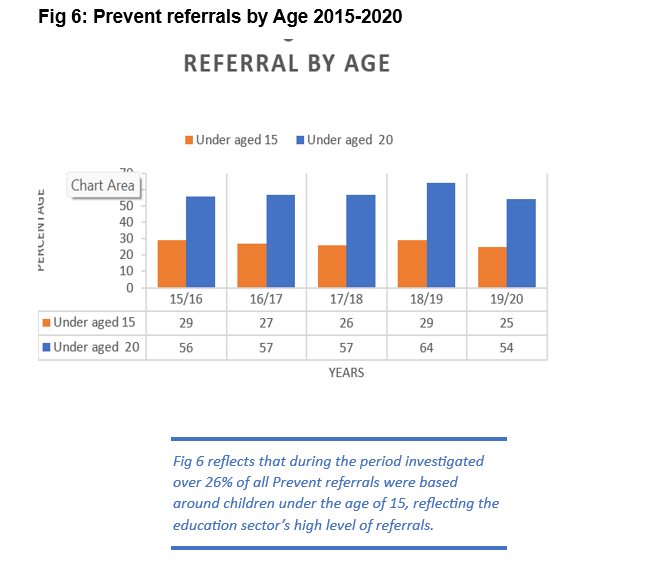
Fig 6: Prevent referrals by Age 2015-2020
Civil Liberties Groups:
Liberty (2023) the UK’s largest civil liberties organisation, describe Prevent as a policy “that simply embeds discrimination in public services” and the policy is further criticized by Amnesty International (2023) which states “ Prevent is a broken system and Muslims are most often wrongly flagged up as carrying a high risk of being drawn into terrorism” and goes further by stating “Prevent is ineffective and a waste of public resources”, this narrative is further attacked by Preventwatch(2023) a UK based community led initiative which states the policy as:
“toxic , racist, Islamophobic and creating a them and us culture”
and these themes were further reported on by Travis, A (2017) writing in The Guardian newspaper article which stated “despite widespread criticism the programme targets Muslim communities”
These viewpoints are starkly borne out by data in the graphs (see Fig 4, Fig 5, Fig 11, and Fig 12) which clearly reflect Muslim boys and young men are being disproportionately referred by significantly larger levels than other groups.
HM Gov (Feb 2023) acknowledge this within its most recent review whereby it reports “research shows the present boundaries around what is termed by Prevent as extremist Islamist ideology are drawn too narrowly while the boundaries around the ideology of the extreme right-wing are too broad”.
Trade Unions:
The Government policy is further criticized by the key leading education trade unions who as stated complete the largest referrals of any referring body, The National Education Union (NEU) the UK largest education union describe Prevent as a policy that “sows mistrust of British Muslims. It should be replaced by strategies based on dialogue, transparency and openness” and is followed by the National Association of Schoolmasters Union of Teachers (2018) (NASUWT) the largest teacher’s union who describe it a policy that “sparked a wide range of criticism” and goes onto say it has a “lack of emphasis on racist and far right extremism” and is further attacked by the University and College Union (UCU,2015) they expressed it will “force members to spy on learners, is discriminatory towards Muslims and legitimises islamophobia”
Case Study 1 Primary School referral of 4-year-old child.
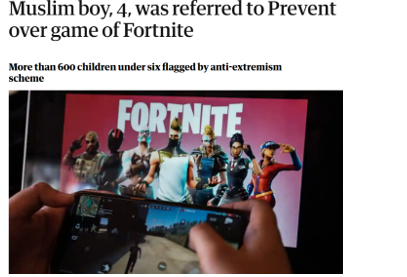
This case study reflects the flawed nature of the referral system, the transcripts of the referral reflect the conversation between the staff and the child was around an on-line game for ownership of an island using a range of weapons. The parents of the child felt “if the boy was white this referral would not have been actioned” this is a prime example of the mistrust Prevent creates in Muslim families and communities.
Case Study 2: Family concerns over referral of 5-year-old child.
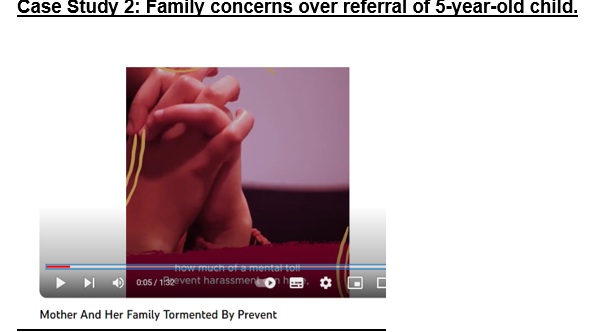
This case study reflects how a 5-year child was used by Prevent officers to harass a Muslim family around a concerning comment that they allegedly made at school, despite not advising parents “what the comment was, when it took place, and what it would mean for the child” the mother further stated “Prevent has made us feel as we are criminals simply for being Muslims”
Critics of civil liberties groups and trade unions might point to education trade unions fighting an “ideological war” Telegraph (2019) on educational reforms however such wide-ranging criticism from a broad base of civil liberty agencies and teaching trade union groups reflect that the Prevent policy is viewed as being distinctly discriminatory and the collective view is radical reform is required urgently
The Need for Change:
Labour’s election victory in July 2001 and their creation of CONTEST as part of their policy agenda related to global terrorist attacks was how Prevent was introduced in 2003, Dorey (2014, p17) quotes Kingdon “the scale of the extent of the problem might not have been realized by policy makers” this is reflected with the then New Labour Government viewing Prevent as playing (Parliament 2010) “a minor role relative to the other strands” and not appreciating the full nature and impact the policy would have when implemented.
Prevent has had multiple Government reviews which have all found it be flawed yet following the attacks in London in 2007 the Prevent agenda was expanded HM Gov (Feb 2015) “specified authorities such as Higher Education Institutions, need to have ‘due regard to the need to prevent people from being drawn into terrorism”.
However, with the UK entering into a decade of collation Government’s, the CONTEST strategy and more specifically the Prevent arm of this strategy had experienced policy drift, and this has continued, policy drift as stated by Galvin & Hacker (2020) as “the transformation of a policy’s outcomes due to the failure to update its rules or structures to reflect changing socioeconomic circumstances”
Prevent introduced at a time of Global crisis with many countries in moral panic over a threat that as Cohen ,S (1972) describes as “a person or group emerges to become a threat to societal values” was as Dorey (2014 p17) quotes Kingdon’s model of policy change reflects “defining an issue as a problem requiring political attention” but was soon overtaken by the political stream Dorey (2014 p17 goes on to state Kingdon describes “election results, changes of administration” can lead to the in-coming Government “with a rather different ideological orientation”
This was where Prevent found itself with a Conservate led Liberal Democrat coalition Government with a focus on austerity and facing huge protests against its austerity program which Heffernan (2016) wrote “in 2015 over 250,000 were thought to have joined the capital’s anti austerity protests” reflecting that public opinion had moved on from security issues and were now focused on more pressing financial issues, Dorey (2014 p13) highlights how a policy can slip into Stage 5 of his Issue attention cycle and the issue “slips off or back down the policy agenda”,
This reflects the need for a far more critical wide-ranging review that any previous Government reviews have offered, any future review must occur swiftly, be inclusive of previously marginalised groups and happen before community tensions worsen further to such an extent that any reform would be meaningless and the Prevent policy is totally abandoned by the education sector, civil liberties groups, and the UK society.
Alternative Government Responses
China:
In response to the Global terrorist threat countries such as China have reacted to in a far more authoritarian and draconian manner with their internal Chinese Muslim communities to supress both internal threats of terrorism and attempt to ensure China is not exposed to terror attacks seen on the Global stage.
The largest Muslim community are the Uighurs based in Xinjiang, Northeast China. The BBC (2021) reports China believes it is dealing with “The threat from separatist Islamist groups” after experiencing their own internal terrorist attacks like those in America in 2001 and in London in 2007, which were carried out mainly by young Muslim men, The UK Government (2023) reported that the Chinese Government in 2014 introduced their own counter terrorism strategy titled “Strike Hard against Terrorism”.
Fig 7 – Map of China highlighting Xinjiang region.
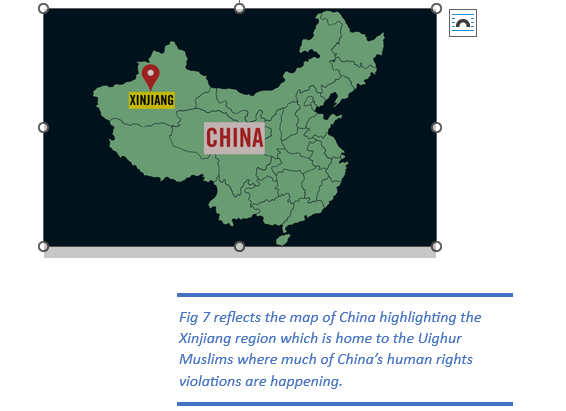
The BBC (2021) reported that since 2014 many of the Uighur religious leaders have been detained and “faced broad charges like “propagating extremism” and “promoting separatism” Amnesty International has reported that the Uighurs are “among the most closely watched population in the world
The Chinese authorities have arrested and jailed Muslims for travelling within the country and abroad, for using social media and for wearing religious clothing, and The BBC (2021) report they have rolled out a “re-education programme” which detains whole families, yet China defends this policy by stating “the purpose of its so-called “re-education” programme in Xinjiang is to stamp out extremism among the Uyghurs and other Muslim minorities”.
The Chinese Government’s response to global terrorism and its handling of its Muslim communities has been widely criticized with Amnesty International (2021) describing the policy as creating a “dystopian hellscape on a staggering scale” and further condemned by the UN (2022) in a report whereby it stated China was committing “crimes against humanity”.
Should the UK follow China’s policy:
The UK applying China’s authoritarian approach would not be feasible or advisable, the two countries have vastly opposed political systems, China has a one-party political system with no free open elections or political opposition, it has a been described by Freedom House (2023) an organisation that tracks freedom and democracy around the world as having a freedom rating of 9/100 and is described as “increasingly repressive in recent years” against the UK which operates within a multi-party political system with open elections every five years and an active opposition parties.
China has received been international criticism over its handling on a range of issues such as: Tibet, Covid 19, Taiwan and Hong Kong even when the UK, USA and Canada boycotted the 2022 Beijing Winter Olympics with the BBC (2022) reporting Iain Duncan Smith commenting China commits “Industrial scale human right abuses” the Chinese Government has not altered its policies.
The UK in contrast is classified as a liberal democracy by Freedom House (2023) with a liberal rating of 79 and is described as “a stable democracy that holds free elections and enforces robust protections for civil liberties” successive UK Governments have sanctioned independent reviews of the CONTEST/Prevent policies and have commented that it needs revision to lessen community concerns as outlined most recently the HM Government 2023 where it states greater funding for “civil society organisations and Prevent practitioners who help protect communities”.
As such for the UK to move away from a mature democratic, liberal but flawed policy to an authoritarian repressive policy such as China’s would not address the concerns around Prevent but escalate existing tensions and ensure large elements of society, as seen around other issues be prepared to protest against a clearly draconian Government policy.
The model China has implemented has been widely condemned, is clearly not only discriminatory and offensive but is in breech of Human Rights and for the UK to follow such a policy would be a disaster for civil rights in this country.
Alternative Government Responses
Norway:
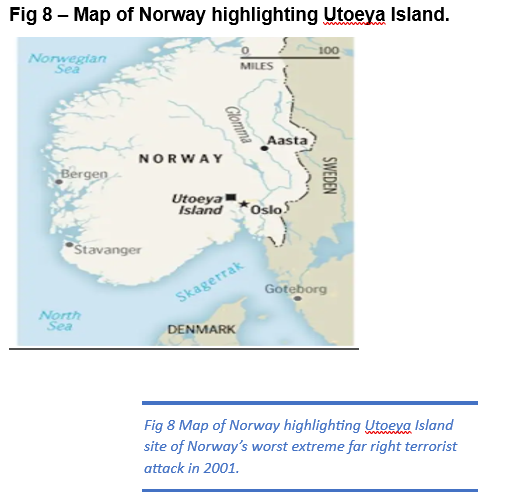
Since 2001 Norway has suffered from multiple Muslim and far-right extremist attacks the mostly deadly event as reported by the BBC (2012) caused “seventy-seven deaths by shooting” in 2011 by a far-right extremist.
The Norwegian Government (Anon 2012) stated its most important task would be
“to prevent persons with close links to Norway becoming involved with terrorism ……
amendments to legislation were introduced addressing far right extremism and Islamic extremism, strengthening existing laws against hate speech, and removing the State requiring proof of:
“a large conspiracy to commit terrorism – “anyone supporting with money, material, recruitment, fighting and related crimes”
these wide ranging adjustments to their existing laws was to address all spectrum of extremist crimes and not focus on one cohort specifically.
The BBC (2012) reported “in a country as famously tolerant, integrated and wealthy as Norway” how these attacks could occur, the 2011 terrorist attacks was carried out by a single person or a “lone wolf” these are classified as being leaderless resistance are now becoming more regularly adopted by Islamist terrorists. The “lone wolf” tactic whereby the “terrorist event” of preparation and execution is undertaken single-handedly makes detection by the State far more difficult to assess and thwart as such Norway looked to toughen laws around supporting such individuals as opposed to increasing the referral processes the UK education sector employs to highlight similar people who are at risk in our education settings.
However The Guardian (2011) reported the ethos on these changes adopted by the Norwegian Government has been to “reform rather than punish” and “to help steer young people away from radicalization”, with former Norwegian Prime Minister, Jens Stolenberg stating his country “will not be intimidated or threatened by terror attacks”, and “would stand firm in defending our values of a open tolerant and inclusive society” this is in stark contrast to the Prevent policy applied in the UK which is viewed at intimidatory towards specific communities based around vague and broad risk factors that do not reflect British Values which also promote tolerance as a guiding principle.
Should the UK follow Norway’s policy:
The UK applying Norway’s liberal approach would be recommended to address Muslim community concerns around Prevent being discriminatory, the two countries have similar political systems, Norway has a democratic multi-party-political system with open elections every five years and an active opposition party which is strikingly similar to the U.K.
Norway has a been described by Freedom House (2023), an organisation that tracks freedom and democracy around the world as having a freedom rating of 100/100 and is described as “one of the most robust democracies in the world. Elections are free and fair, and power regularly rotates between parties. Civil liberties are respected”
As such for the UK to refine the existing Prevent policy would be advisable following a more liberal approach such as Norway’s, which has addressed the overall threat of terrorism and amended its existing legislation to address the changing face of terrorism and individuals working alone rather than adapting existing laws that place a greater burden on one area of society such as education. This has allowed Norway to enshrine its liberal views as an open society and if the UK followed suit would by doing similar and this contribute to deescalating community tensions.
A major issue to address in any review of the existing policy is consideration of how the UK Government would approach the problems around CONSEST/Prevent, the problem has been acknowledged by successive U.K. Governments but any meaningful action has been deferred as Dorey (2014) states
“Ministers will recognise the need either to introduce a new policy or perhaps modify an existing policy, but will want these to be endorsed by some form of independent and impartial inquiry, to imbue greater justification or credibility”
as such the UK Government must do more to act upon the recommendations the most independent review HM Gov (2023) highlights
“There is room for improvement” “must address all extremist ideologies proportionately” – Prevent work has to be held to account” -The Home Office must create a new unit to examine issues and complaints from within the system and wider public – address the misaligned with mixed, unclear or unstable referrals”
Section 3 Recommendations
The Conservative led Government Review 2023 is the most recent review of this ongoing contentious Government policy and offers detailed criticism and policy amendments which has been welcomed and contested in equal measure.
The review of this policy described as toxic by many key stakeholders does not still address the fundamental concerns that it is discriminatory and Islamophobic, in part because the Muslim community viewed the author William Shawcross as racist and anti-Islamic as reflected by Amnesty International (2023) reporting the authors historical remarks such as “Islam being one of the greatest and most terrifying problems of our future” was a factor in the report not being received positively, as was William Shawcross replacing the original chair of this review Lord Carlise, who was a staunch advocate of Prevent and was removed in 2019 a decision reported in The Guardian (2019)whereby RightsWatch a UK a civil liberties organisation described the decision as “his long-standing objection to any kind of criticism or overhaul of Prevent is no secret, this meant the review lacked buy-in and cooperation from those it most needed to engage”.
It is this buy-in and involvement which I feel needs addressing for any meaningful reform.
Recommendation 1 – Bespoke Forums :
My first recommendation would be to liaise with the NASUWT’s Black, Minority and Ethnic (BME) steering committee and ask if they would allow me work with them to prepare and then they deliver a BME conference workshop to address issues around Prevent.
As this is a dedicated space for BME teachers my delivery of the workshop would not appropriate in the first instance but an open forum, safe space where trade union members could discuss their own lived experiences would be invaluable to support any recommendations the trade union might recommend at later point, to support this, I would use a questionnaire I have created (Fig 10) to sample BME teachers’ opinions around Prevent.
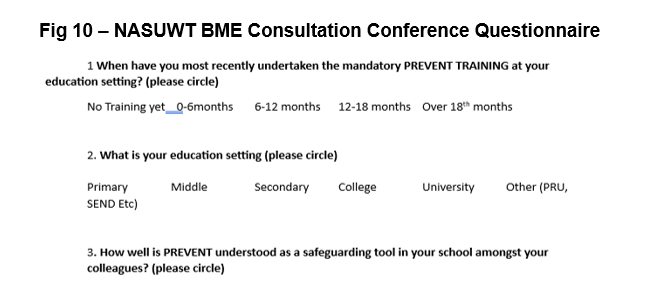
This model would be best suited to a regional approach where educators in the West Midlands are surveyed, similar teaching cohorts such as the NASUWT Disabled, Supply and Lesbian-Gay-Bi-Trans-Queer-Intersex (LGBTQi) Teachers consultation conferences could be asked to participate and share their opinions around Prevent in their own dedicated forums which should allow findings to be compared between groups and not be centred solely on one cohort and open to criticism that only BME teachers are being consulted on Prevent reform.
This consultation model could be delivered to other regions of the country and longer term at the wider National Conference to help shape future education policy recommendations.
Recommendation 2 Refinement of the Educational referrals:
Within the BME consultation process specific areas of the referral system could be assessed in more detail, investigation on how the Prevent referral system is being applied, this referral system known as a Channel referral is clearly flawed and has been commented by The HM Gov (2023) as “misaligned”.
Fig 11 Age of Channel referrals 2015-2020
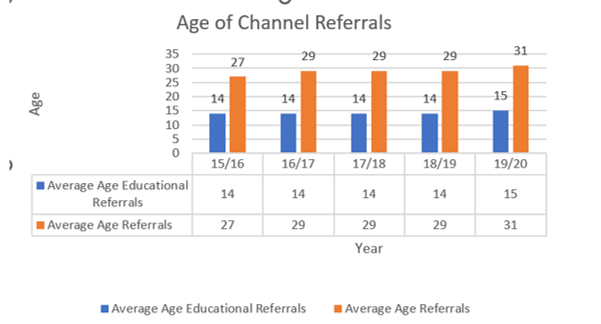
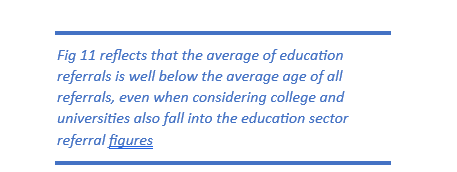
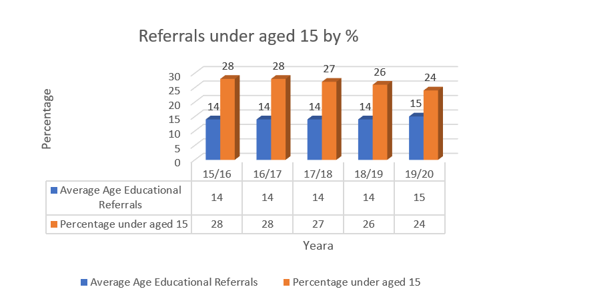
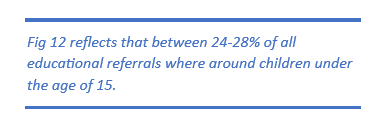
With the education sector creating more referrals than any other sector the BME consultation group could explore the reasoning behind the alarming statistic that young Muslim boys are the highest proportion being referred, with the average age of referrals from all groups being just fourteen during the period investigated. However, the data reflects that within this average range of educational referrals, 26% of students were under the age of fifteen.
Fig 12 Percentage Age of Channel referrals 2015-2020
HM Government does not currently differentiate within its data points between the various education settings and their referrals and a more bespoke Prevent system for the diverse nature of education settings should be formulated considering the ages in each. Furthermore, students’ Special Educational Needs (SEN) are also not currently considered before any referral is generated and those with SEN or with mental health issues should be offered alternative provision rather than a Channel referral. HM Gov (2023) highlights this when it states “Prevent is carrying the weight for mental health services – people who do not pose a terrorism risk are being referred to Prevent”
As such the overall referral system needs urgent reform breaking the referrals down clearer by age, and adjusting a one fit all approach to a sector which refers students from ages 3-18 years old on the same risk factors.
By utilising the BME and wider consultation conferences educators from all settings will be at the heart of this review alongside the collation of data highlighting if students should be removed from a Channel referral due to specific criteria being considered such as Age, SEN and mental health issues. This should have a positive impact on improving the Muslim community concerns around Prevent referrals and will address any criticism that the research has been too narrow and not covered education settings/educators from various backgrounds.
Recommendation 3 West Midlands Pilot Project:
The introduction of a West Midlands Pilot scheme where a region applies these open forums as outlined in my first recommendation and the review of the Channel referral criteria across the education sector as outlined in my second recommendation, to fully assess the impact of reforming the referral system and placing communities at the heart of this reform is required.
Regional Pilot schemes play a valuable role in rebuilding trust in communities and allowing local leaders and people to take greater control over issues that affect that area. However all communities need to feel valued and that their opinions are allowed to be expressed and taken in consideration, as such any regional pilot scheme must offer all communities the opportunity to contribute. The introduction of a West Midlands pilot scheme where a region applies these open forums as outlined in my first recommendation and the review of the Chanel referral criteria across the education sector as outlined in my second recommendation, to fully assess the impact of reforming the referral system and placing communities at the heart of this reform is required.
In 2017 The Greater Manchester Combined Authority (GMCA, 2018) created its own “Preventing Hateful Extremism and Promoting Social Cohesion Commission” which found:
“people wanted to be involved in their communities but are hindered by a lack of community spaces to do so, research is required into what the community experiences and beliefs of PREVENT are, there is a crucial need to allow people to voice their opinions – People feel ignored and silenced”. As such a similar pilot scheme delivered in the West Midlands would address many of the concern communities have raised around The Shawcross review. Initially this pilot scheme will need support from one of the political parties in the region, I believe the Birmingham Liberal Democrats (2023) who state: “ we believe that strong communities are built working side by side and decisions are better taken when local factors are considered” and goes on to state:
“Birmingham is a vast city and a one sized approach does not work” would be best placed to support this both regionally and later nationally.
The Liberal Democrats have been vocal in their condemnation of Prevent with the party attempting the scrap the Prevent policy as reported in The Guardian (2016) where the party’s Home Affairs spokesman stated “it could no longer support the programme” and would recommend “a more community focused strategy”, with the support of the liberal democrats in Birmingham the recommendations outlined could be implemented with the introduction of dedicated public forums, bespoke focus driven reviews of educational referrals and a polit scheme placing the communities and other stakeholders at the heart of any reform, this could then be used to gain cross political party support when working alongside other influential groups such as the West Midlands Combined Authority (WMCA) within their inclusive communities programmes which should contribute to other political parties supporting this pilot scheme.
Conclusion:
The Implementation of these three recommendations will begin to address the overarching concerns raised in this policy brief, these being the baked in discrimination, bias and Islamophobic elements the Prevent arm of CONTEST has within it, improving the education referral system which is clearly in dire need of amending to incorporate removing certain risk factors which will in turn should reduce Channel referrals and ease community tensions and finally will build in transparency and inclusion for all communities and community stakeholders, only then will the UK Government have refined an outdated poor policy which will support its ongoing security needs.
 PJR Education Consultancy
Leave a comment