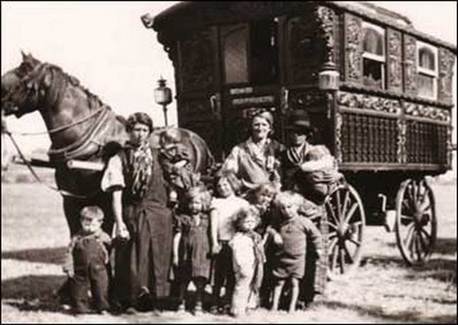
Figure 1 – A traditional Irish Traveller family – 1920’s:
Methodology:
To undertake this research a case study methodology has been applied to investigate a particular community.
Yin, R. (2018 p18) describes a case study as:
“A case study is an empirical inquiry that investigates a contemporary phenomenon in depth and within its real-life context, especially when the boundaries between phenomenon and context are not clearly evident”.
The case study will also allow my own lived experiences from growing up in the ITC to sit alongside primary and secondary research processes. The use of qualitative and quantitative data and academic grey material will also be utilised, which will as Cresswell, J.W (2018 p14) comments:
“Qualitative research is a situated activity that locates the observer in the world, research methods consist of interpretive material that make the world visible”.
Furthermore, discussion and interviews with community members, photographs of important cultural events and the importance of storytelling will also be utilised which will as Bryman, A (2016 p4) base this social research method around an area important because:
“The existing knowledge about an area in which a researcher is interested forms an important part of the background within social research takes place”.
By applying these approaches, it will allow the report to offer an assessment of the evolution of this community in a vibrant, rich and efficient manner and highlight how it has suceesfully sustained itself whilst adapting to greater levels of Government scrutiny and involvement.
Figure 2 Cahirmee Horse Fair, North Cork, Ireland:
Literature Review:
The concept of community has long been explored by sociologists with many competing opinions on how and where a community fits within society, The Ancient Greek philosopher Aristotle discussed the concept of community within the sphere of governance of both society and the community, having no distinction between the two as Delanty (2010 p1) outlines:
“For Aristotle there was no essential difference between the social and the communal, the idea of society was associated with friendship”.
Delanty (2010 p18) goes on to explore how the concept of community has evolved and considerably altered around the turn of the 20th Century, where he states:
“A new conception of community emerged, with the rise of sociology and anthropology, community began to be conceived in terms of a culturally defined social group.”
Building on this work by Delanty a more nuanced definition of a community Grow, G & Allen, G (1994 p1) describe this as a:
“Convenient shorthand term for the broad term of local social arrangements beyond the broad realm of social arrangements beyond the private sphere of home and family”
This is further reflected upon by Mooney (2009 p2) who highlights community is often used to refer to “good social relations because it suggests groups of people who care about and for each other”.
Reflecting the changing nature of how the perception of community has shifted Delanty (2003 p21) discusses this division of society and the community when referring to Tonnies who stated:
“The relationship itself, and also the resulting association, is conceived as real or organic life
– this is the essential characteristic of the Gemeinschaft (community): or as imaginary hand mechanical structure – this is the concept if Gesellschaft (society)”
These terms which do not directly translate from German to English relate to the structure and nature of the community following traditional rural living and behaviours including cultural and religious events (Gemeinschaft), this was more common and widespread in rural areas Tonnies, F (2002 p42) described Gemeinschaft as being ‘the supreme form of community”, where Gesellschaft explains citizens living within an urban or city environment not following these traditional values, but the norms and societal expectations imposed on them through things such a legislation Tonnies, F (2002 p35) describes this as ‘transitory and superficial’ (Gesellschaft).
Finally, Tonnies, F (2002 p34) summarizes that:
“Gemeinschaft is old: Gesellschaft is new – accordingly Gemeinschaft should be understood as a living organism, Gesellschaft as a mechanical aggregate and artifact”.
The ITC are a community that has experienced and continue to struggle with this evolution, where once viewed as part of the wider society as a whole, groups were not settled in one specific location but roamed as seasonal agricultural work and cultural events dictated, it therefore become in the eyes of wider society as the definition of community evolved a distinct indigenous minority group from the island of Ireland which has striven to retain its identity by attempting to remain connected to its traditional values (Gemeinschaft) despite the regulations and legislation imposed on it by society and urban/city communities (Gesellschaft) who feel challenged by these itinerant communities and their traditions.
Simmel, G (1903 p11) discussed these struggles when stating:
“The deepest problems of modern life derive from the claim of the individual to preserve the autonomy and individuality of his existence in the face of overwhelming social forces, of historical heritage, of external culture”.
The ITC have strived to retain its historical heritage and culture in the changing face of societal norms which Simmel, G (1903, p13) highlights “punctuality, calculability and exactness are required for metropolitan life”, not traits that rural communities and itinerant communities have historically adhered to,
It is these social forces which this report intends to investigate and how these have altered the ITC.
Figure 3 A traditional Traveller’s home and mode of transportation:
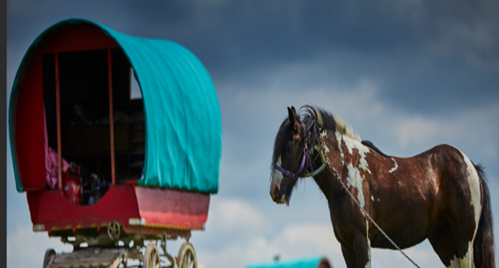
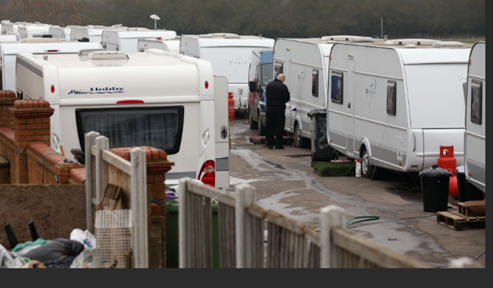
Figure 4 A modern Traveller’s fixed site and mode of transportation:
The Irish Traveller Community Profile:
The title “Irish Traveller” is as Henry, D (2022, p72) comments: “A state-imposed term- the community instead refer to themselves as Pavee or Minceir”.
The ITC have historically avoided engaging with Governments and their data collection, fearing persecution and discrimination, policies by the State towards itinerate communities can be traced back to medieval times with Hawes, D & Perez B (2006 p11) writing:
The 1551 Act forbade all tinkers, and such like vagrant persons to travel from place to place without a license under penalty of 14 days in jail”.
As such a clear picture of the size of the community has at times been difficult to create, the Irish Traveller Movement (2016) reported:
“There are around 31,000 Travellers in Ireland making up around 0.7% of the population, with a further 15,000 Irish travellers living in Great Britian”.
Many Irish traveller families left Ireland between 1840-1850 during “The Great Famine” an agricultural disaster which as Donnelly, J (2011) reported was “severely worsened by the inaction of the British Government”. This was the catalyst for the ITC like millions of Irish citizens to leave Ireland as part of the Irish diaspora as Stamp, J (2014) states:
“The Great Potato Famine of the 1840s, in which a million people are estimated to have died and led a further two million to emigrate”.
When investigating the Office of National Statistics (ONS) specific data on the Irish Traveller populations was only comprehensively collected from 2011 onwards, however this also included Gypsy numbers, as such further investigation to focus solely on the ITC community would be required, however for the purpose of this report the 2011-2021 data is used to compile a partial profile of the ITC.
Figure 5: Irish Traveller Population -2011-2021
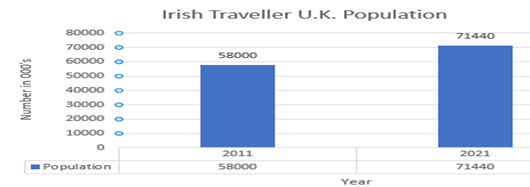
Figure 6 Locations of ITC Communities within the U.K 2021:
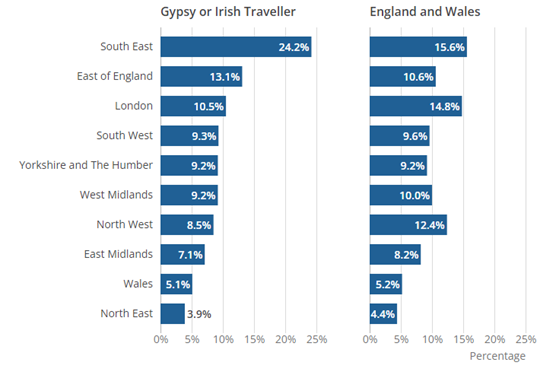
Figure 6 reflects that the ITC have settled across the United Kingdom highlighting that community is not as Monney, G & Neal, S (2009 p16) state: “community has moved on from the notion as being in a time and particular place, it can now be manifested beyond place and locality.”
However, Traveller Times (2023) when exploring the increase in the ITC and fixed accommodation sites across the U.K. reported:
“Over two-thirds of England’s local planning authorities had failed to include Traveller sites in their development plans – despite 29 years of government policy and guidance that required them to do so”.
Figure 7 Accommodation types for Gypsy/Irish Travellers in 2021
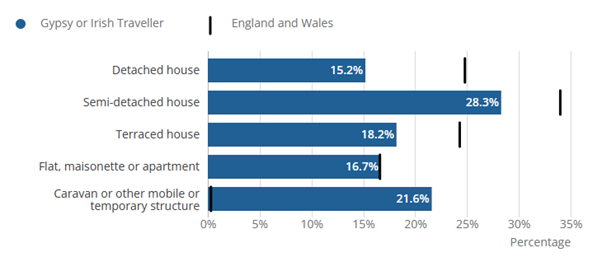
Figure 8 The population pyramids of Gypsy/Irish Travellers in the UK 2021:
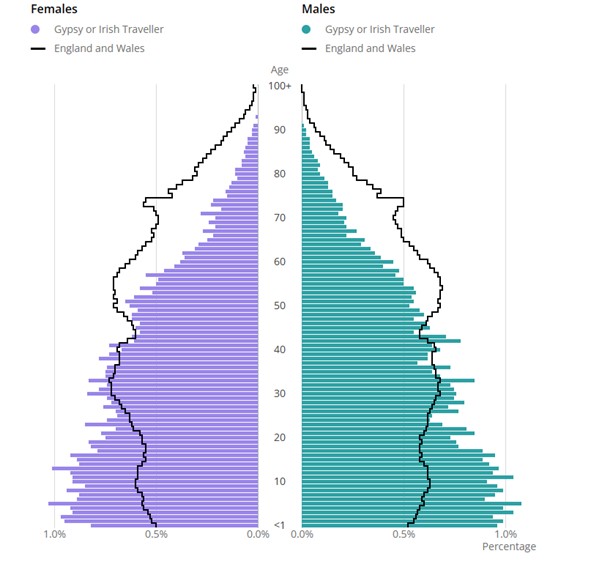
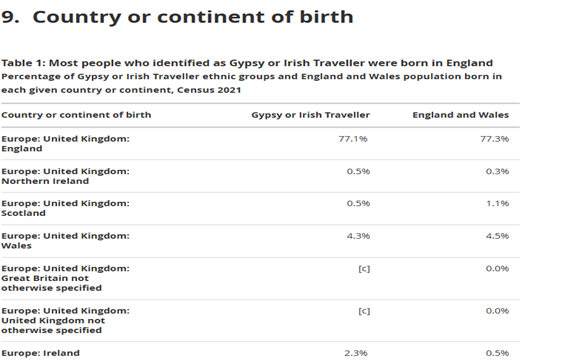
Figure 9 The country of birth for Gypsy/Irish Travellers in the UK 2021:
To support a deeper understanding of the ITC a community profile could be commissioned, this as Hawtin, M & Percy-Smith, J (2007 p4) describe as:
“Undertaken or initiated by different organisations including the communities themselves covering both the needs and resources and the whole range of issues affecting that community”.
However, for the purpose of this report Jenkins, R (1997 p13) “basic anthropological model of ethnicity” will partially be appliedto gain greater insight in the ITC, Jenkins R (2007 p14) discusses “ethnicity is concerned with culture- shared meaning” and goes onto state “ethnicity is no more fixed or unchanging than the culture in which it is produced or reproduced”.
By partially applying this framework this report will be critically examining the anthropological approach, Jenkins R (2007, p5) describes this as:
“Focused on the dimensions of social life, more than others: Symbolism, religion, kinship, customs and communal identity”. As such this will report will focus on applying Jenkins ethnicity framework around the Tribe/Ethnic Groups, Nation/Nationalism and the Cultural aspects of the ITC with the UK/Republic of Ireland Governmental policies towards the ITC referred to throughout these sections.
Tribes/Ethnic Groups:
The history of the ITC has passed through generations by oral history, Howarth, K (1999) states: “Oral history should be given a far greater priority than it has as present, it should be seen as a vital tool on collecting research”.
Oral History plays a key role in the ITC, Okley, J (2003 p1) describes this further when stating: “Travellers have scarcely written their own history, theirs is a non-literate tradition”.
Every family has a male figure responsible for the telling of tales, reciting history and recalling key events. Khaleei, H (2016) writing in the Guardian when interviewing Richard O’Neil unique as a contemporary gypsy writer describes this as:
“In a culture with a strong oral tradition, stories are the way family history, knowledge and values are passed on”.
The ITC has been historically perceived as tribal by wider society, this is in part as Okley, J (2016 p173) states: “Traveller’s use ‘surnames’ to accentuate their associations with selected kindred, – travellers have used the word “tribe” in connection with their surname”.
This connection is sharply reflected in the 2011 film Knuckle (Palmer et al., 2011) which investigates various tribal/family feuds between the Quinns, Joyces, and Nevins with the family surname being a source of pride, kinship and reason for fighting to preserve family honour, Henry, D (2022, p28) stresses the importance of honour within the ITC when reporting: “There is honour in the family name so you work hard to protect that”.
Furthermore Henry, D (2022 p81)states “There remains great pride and honour in the family name enabling the clan spirit”.
Figure 10: Netflix Documentary on Irish Traveller Tribe/Clan fighting feuds:
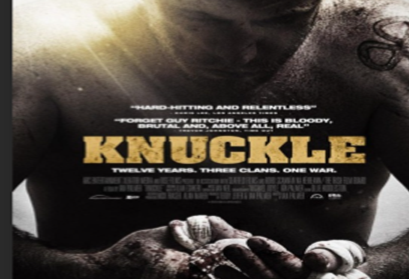
Jenkins, R (2007 p17) discusses the concept of the tribe in further detail when stating “the concept of the tribe accomplished two things, it distanced the tribe from civilized society and could organise these as “non civilized”.
This anthropological classification of the ITC as a tribe has led to moral panic over a threat that as Cohen, S (1972 p35) describes as “a person or group emerges to become a threat to societal values” this is reflected by Meredith, R (2022) writing for the BBC stating that: “Irish Travellers suffer some of the worst discrimination and poverty of any ethnic group in Europe”.
Jenkins R (2007 p18) discusses how Barth replaces describing the tribe to a “less embarrassingly ethnic group” which is:
“Biologically self-perpetuating, members of the group share basic cultural values and identified themselves as belonging to that group”.
The ITC historically a tribe, are now classified as a distinct ethnic group, which The Irish Traveller Movement (2016) reported:
“Travellers were formally recognised as an ethic group by The Irish State on March 1st, 2017. Ethnicity relates to the collective set of beliefs attitudes, values, norms and language that Travellers share that make them Travellers”:
Figure 11: BBC Website reporting Irish Traveller ethnicity recognition:
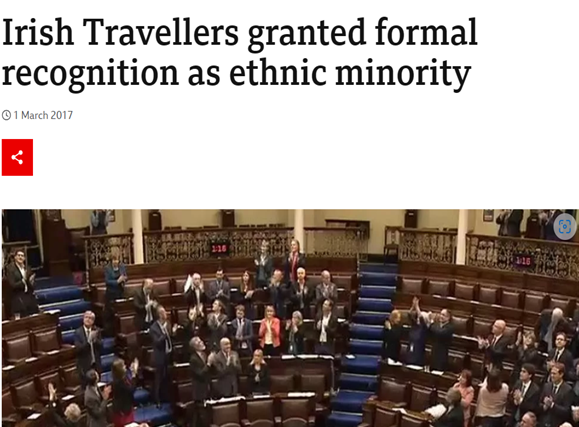
Henry, D (2022 p73) discussed the importance of this Irish government recognition when stating:
“This has paved the way for them to reclaim their history after years of exclusion, discrimination and being “outsiders” in their own country”.
Nation/Nationalism:
National identity is one key area that differentiates the ITC from other itinerant/nomadic communities such as Gypsies and Romanies societies.
Whilst Gypsies or “Egyptians” were first recorded as Okley, J (2017 p3) states “in the British Isles in 1505, they presented themselves to James IV as pilgrims” there origins were from Western Europe or possibly India, in comparison Irish Travellers originate from Ireland and to a lesser extent Scotland and their language is as Okley, J (2017 p18) states is “a secret language including Shelta and Gammon”.
It is this national identity to their ancient land, now modern-day Ireland and the traditional language dialects that is a core structure of the ITC as a community and one that supports the perpetuation of the community, The Irish Government commissioned The National Council for curriculum and assessment (NCCA) a report that found the language of the Shelta/Gammon/Cant dialects were recorded:
“Considering these Old Irish links of Cant/Gammon, suggests that this carries us back to a period which is anterior to the 11th Century. NCCA (2023)
This importance of language as a sense of identity to a community is highlighted by Jenkins, R (2007 p47) whereby he writes:
“An individual’s sense of ethic membership may depending upon context be reflected in markers such as language and religion”.
Delanty, G (2010 p151) discusses nationalism: “is most compelling where it has taken the form of a political movement seeking a goal of independence”.
The ITC have its historical roots in Ireland, centuries before the now Republic of Ireland was formed in 1922, many within the ITC did not participate in the war of independence, or the prevailing identification as citizens of this new Nation, the ITC saw themselves and still do as an Irish Traveller above being a part of the modern nation of Ireland, Henry, D (2022 p81) when reporting on an interview with a young man from the ITC wrote:
“One shouldn’t be proud to be Irish, but one should be proud to be a traveller”.
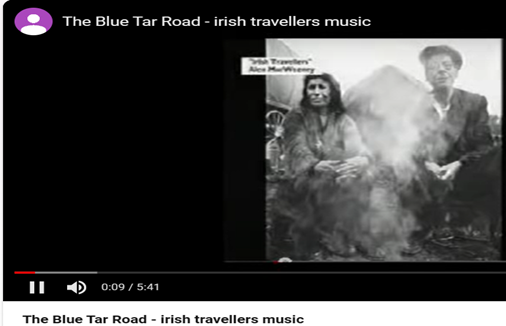
This is in part reflected in the traditional songs both the ITC and the nationalist Irish communities sing at cultural events, the former sing about travelling life such as “The Blue Tar Road” with lyrics reflecting the life of traveller.
“I am a true born Irishman, a traveller am I
My home’s the road, no fixed abode, I must travel till I die
For few men give me camping space and fewer call me friend
Oh the hard road for the traveller, I must travel till the end”.
Figure 12: The Blue Tar Road – Irish Traveller music
The Irish Nationalist community sing about overcoming British colonial rule with songs such “Black & Tans” with lyrics reflecting the Irish struggle for independence.
“Come out you Black and Tans, come out and fight me like a man
Show your wife how you won medals down in Flanders
Tell her how the IRA made you run like hell away
From the green and lovely lanes of Killashandra”.
Figure 13 Come Out Ye Black and Tans – Irish Nationalistic music.
Jenkins R (2007 p84) describes nationalism as: “nationalism involves almost by definition identification and social categorization: inclusion and exclusion”.
The ITC due to their self-identification as originating from the clans of ancient Ireland and travellers above any sense of being Irish has led them to be categorized as uncivilized and excluded from mainstream society.
Figure 14 The Irish Traveller Movement Flag.

Culture:
To support the perpetuation of the ITC, cultural events, customs, and symbolic aspects of the community take on huge significance to ensure regeneration through participation of these by younger generations, examples of these include religion, marriage, language (discussed page 21) cultural events and the connection to horses/horse trading.
Jenkins R (2007 p14) describes culture as:
“The definitive characteristic of human beings, the capacity for which unites us all in essential similarity”.
Religion plays an important part of the ITC with many identifying as Catholic, Henry, D (2022 p72) highlights; “Travellers are Catholic and Gypsies are mainly Church of Ireland (Anglican).” This religious identification is highlighted by again by Henry, D (2022 p89) when interviewing a member of the ITC who stated: “I am proud to be a Roman Catholic”.
The devotion to religion and religious events such as baptisms, confirmations, weddings, and funerals are integral to the ITC and have taken on greater importance with larger numbers now living on fixed sites making these religious events important opportunities to energize and renew the culture, this is reflected by the Catholic News Agency (CAN 2018) who reported:
“Despite generations of poverty and prejudice from both the government and ordinary Irish citizens, the faith of the itinerant Irish Traveller community today is strong.”
Marriage within this religious context plays an integral part of the ITC, marriage as Henry D, (2022 p79) highlights: “Girls tend to marry young – Few Travellers marry outside the community”. This is an example of endogamy, the process of protecting, continuing, and sustaining the community by marrying from within it, as Okley, J (2016 p157) states: “ethnic endogamy was both the ideal and remains the practice of the majority of travelling families”.
Another area which sustains the ITC are gatherings, or Horse Fairs, as Henry, D (2022 p31) explains:
“Annual horse fairs remain steadfast in the community; this is more than a horse fair and annual gathering – a summit almost, where lifelong friends/families gather for catch up on news and family happenings.”
Appleby Horse which has taken place since 1685 under a Royal charter from James II, has huge cultural significance andHenry, D (2022 p32) explains its importance to perpetuating the ITC when stating Appleby:
“Attracts many young travellers who have a very enjoyable times participating in an event that brings them closer to their cultural roots”.
At these horse fairs traditions of the ITC cultural history are expressed, these include “flashing” and “chopping”. Travellers Times (2017) explain flashing as:
“The ‘Flash’ has a very serious purpose and is integral to the traditions and culture of the Appleby Horse Fair – it is the testing run for the horse dealers – the sellers/buyers that have been coming to Appleby for centuries”.
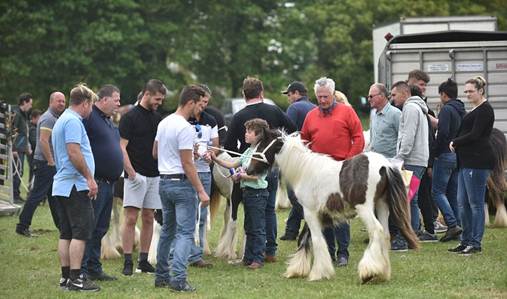
Chopping relates to the buying and selling of horses at the fair, when two traders exchange or buy/sell a horse, as Okley, J (2016 p197) states” The deal is publicly clinched when the two men slap their right hands together in a “chop”.
However, the ITC have face discrimination when attempting to hold religious gatherings, Deegan, G (2023) writing in the Irish Times reported how an Irish Traveller woman was barred from church: “Father Cummins refusal to allow Traveller woman to attend First Communion”.
Another example of discrimination around ITC cultural events was reported by the BBC (2024) where it highlighted: “An Irish Traveller has received compensation after a pub refused to host his daughter’s christening”.
Finally, the channel 4 television show “My Big Fat Gyspy Wedding” has been heavily criticized for portraying the traveller and gypsy communities poorly, McDonald, H (2011) writing in The Guardian newspaper reported it left the ITC:
“With a deep sense of embarrassment and shame that such a narrow, misrepresentative and unjust portrayal of their community and culture”.
As such, the ITC are under constant pressure to assimilate and face a constant struggle experiencing overt discrimination when trying to maintain their cultural identity and sense of community spirit that resonates from a Gemeinschaft perspective in an ever-increasing hostile Gemeinschaft society.
Figure 15: Appleby Horse Fair and “Flashing”.
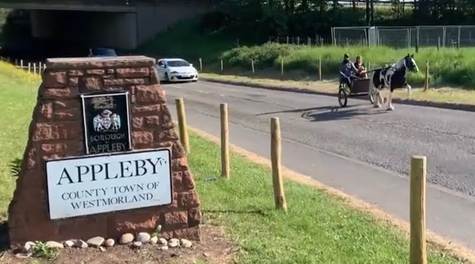
The Market town of Appleby
“Flashing”
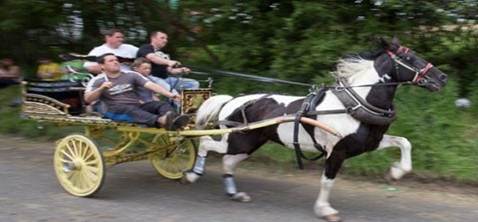
Figure 16: “Chopping” and washing horses in the river Eden, Appleby horse fair.
“Chopping”
Washing horses in the river Eden
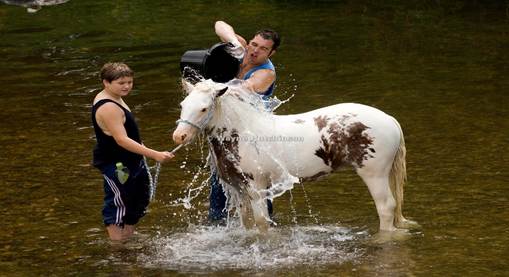
Figure 17: “Channel 4 “My Big Fat Gypsy Wedding” television program.
To support the ITC sustain and maintain its distinct community and culture more needs to be done by Governments that have a ITC within their countries and by the ITC itself.
Recommendation 1: Reclassification of ITC:
Gov. UK (2022) classification (see p3) that all itinerate groups are not specific ethnic groups is outdated and incorrect. The negative stereotype that all Gypsies, Roma, and travellers herald from the same lineage and have the same religions, language and customs is a flawed hypothesis which has been comprehensibly discredited.
Within the next decade and before 2031, when the next national census is due, Governments need to alter their data collection processes to separate and collect relevant information on these groups to better support maintaining these communities.
Within this data collection greater protection should be afforded the ITC under existing legalisation such as the Equality Act (2010) which as Henry D (2022, p17 notes:” ethnic groups are protected against discrimination by the Equality Act (2010) under groups with “protected characteristics”.
The application of existing legalisation around the creation of fixed accommodation sites (as discussed p13) could hold local planning authorities to account when not delivering on Government policy requiring, they do so.
Furthermore, greater application of the Equality Act (2010) around discriminatory practices (as outlined on p19) would address the ongoing issues the ITC face, however as Declan, H (2022 p90) states:
“Travellers must take on board and address the negative public perceptions held about them and accept responsibility, to seek ways to restore their reputation”.
This reflects that the ITC must engage with the State and State institutions to work collectively to maintain its culture and identity.
Recommendation 2: Greater representation of the ITC:
The ITC collective views should be heard and included when considering solutions to issues around housing, education, health, and discrimination matters, for this to occur greater representation from the ITC needs to happen, with more community members participating in the formal creation of policies and legislation.
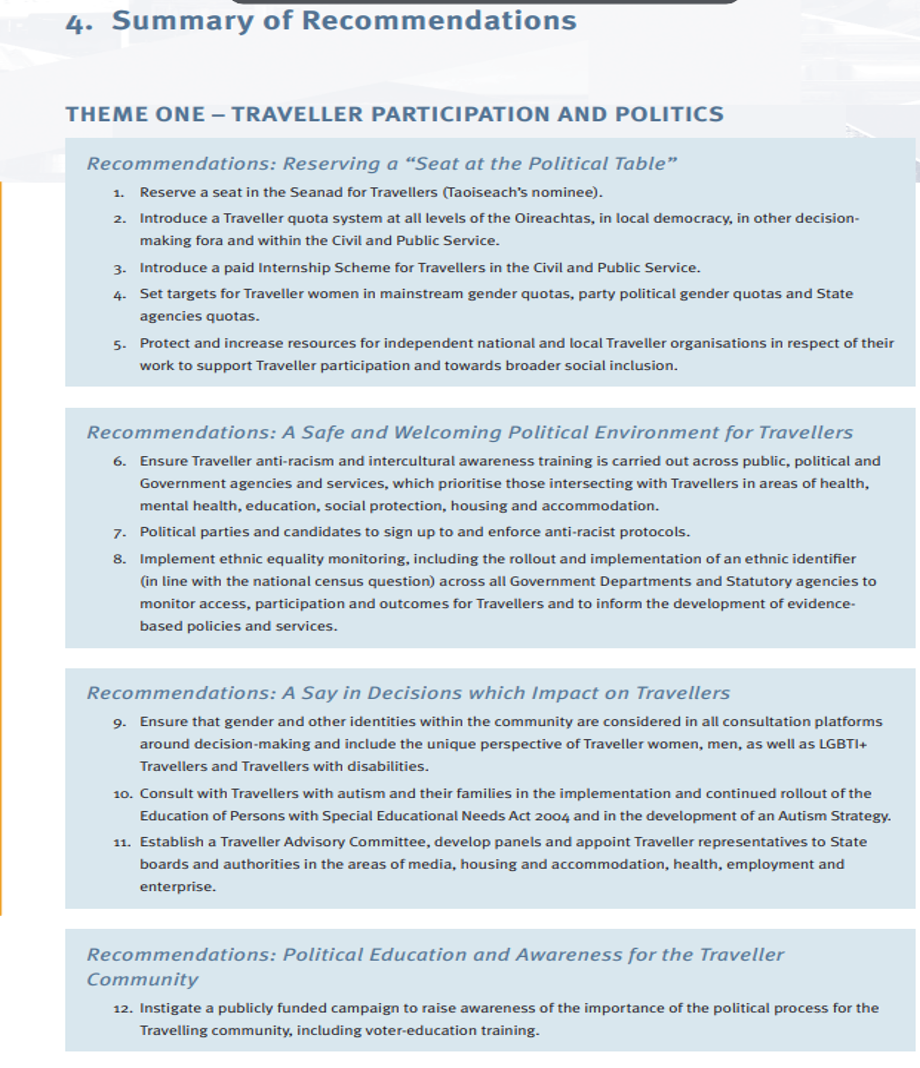
The Irish Government to support greater participation commissioned a report on “Traveller’s participation and politics” in which Sen. Coghlan, P (2020) reported its aim was to address: “the lack of political representation for the Traveller community at local, national and international levels”.
From this report came recommendations (see fig 18) which led to the appointment of the first female traveller sitting in the Irish Parliament.
BBC News (2020) reported:
“Eillen Flynn made history as the first woman from the Travelling community to sit in the Seanad”.
The U.K. Government should implement similar schemes to activate participation of the ITC in England, which as Henry, D (2022 p89) comments will address the view that:
“State and State institutions being to blame for having taken the power and rights away from Travellers”.
Through this political participation the ITC will have the opportunity to shift the perceived imbalance of discriminatory polcies onto policies that sustain their community.


Very interesting and informative read Thank you
LikeLike