The case study will conclude with recommendations that more needs to be done by regional decision makers and at Government level to support young people within this community to address, support and improve their opportunities in selecting more suitable personable relevant education choices, offer greater public transport networks to the village and create more affordable housing to facilitate young people being able to remain in their village.
Figure 1 – The village sign of Shareshill.

Methodology:
To explore the issue of young people experiencing social exclusion when living in a specific rural community a case study approach methodology has been utilised, this will allow analysis of successive Government neo-liberal policies on the community to be conducted, added to my own lived experiences from residing in this village, primary and secondary research processes, qualitative and quantitative data reviews and visits to the community, interviews and conversations with community members will all be utilised when exploring the economic factors they directly face, Bryman, A (2016 p4 ) describes this social research method around an area important because:
“The existing knowledge about an area in which a researcher is interested forms an important part of the background within social research takes place”. The case study will also utilise qualitative research-based mmethods such as application of field notes, photographs of the village and surrounding area including education settings, employment opportunities and public transport in the village which will as Cresswell (2016 p14) comments allow:
“Qualitative research is a situated activity that locates the observer in the world, research methods consist of interpretive material that make the world visible”.
By applying these approaches within the case study, it will reflect the issues this community face to be laid out in a vibrant and rich manner and allow the visualization of the economic factors causing social exclusion in a succinct but efficient manner.
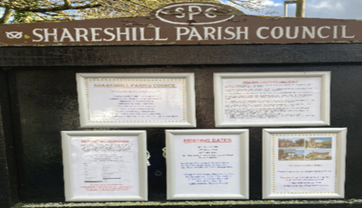
Figure 2 – The village notice board of Shareshill.
Shareshill – A rural community
Figure 3 – Map of United Kingdo
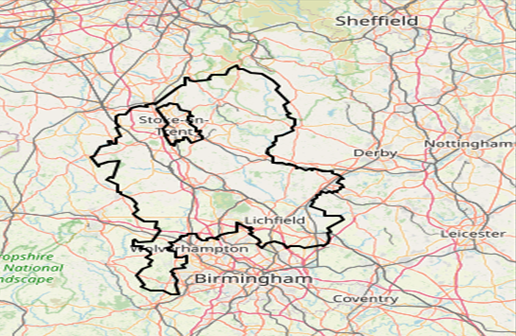
As the map reflects Staffordshire is a landlocked County with major cities such as Manchester and Birmingham in proximity and other settlements such as Stoke, Tamworth and Burton-upon Trent (not visible on the map) located within and spread across its boundaries. The County is also made up of smaller towns and villages such as Cannock, Featherstone and Shareshill, Nomis (2024) report that there are “878,800 residents” currently living within Staffordshire.
Figure 4 – Map of Staffordshire
Shareshill is a small rural community situated in the Staffordshire countryside, its history dates to the 14th Century where it was historically a settlement for farmer’s and agricultural workers, in 1851 the population of the village was 594 residents (White, 1884) which has slowly increased, during the 2011 Census the population had risen to 759 residents (ONS, 2011) an increase of 27% in 160 years.
In comparison Wolverhampton’s population rose from 49,985 residents in 1851 (Briercliffe, S 2016) to 248,732 residents in 2011, (ONS, 2011) a rise of 397% in the same period. This reflects the dramatic growth of the City of Wolverhampton and where resources and investment has been prioritised.
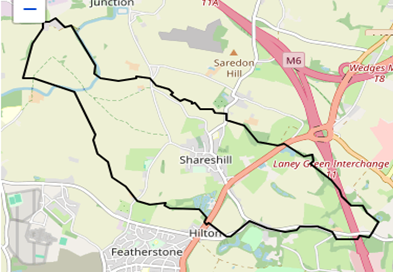
Figure 5 – Map of Shareshill
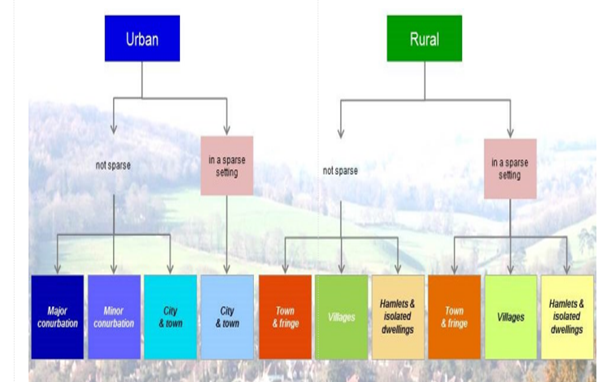
The Department for Environment, Food and Rural Affairs (2016) define a rural community as one that “falls outside of settlements of 10,000 resident population” however this definition is too vague to fully describe the village this case study is based around, as such a clearer definition would be the HM Gov (2017) Rural Urban Classification for Output Areas (RUCOA) this allows for a clearer analysis of a specific location by breaking that area down from a urban or rural setting and within these having sub-classifications for rural areas thereby breaking these down further such as Town/Fringe, village and isolated settlement, through this classification it can be assessed that Shareshill is rural and sparce settlement once this more detailed classification is applied.
Figure 6 – View eastwards towards the M6 from Shareshill

Figure 7 Rural – Urban classification
Rural communities have long been underrepresented in Government decision making and political parties such as The Co-operative Party have called for a Rural Commission to address:
“9.7m people (17.1%) in the UK live in rural areas according to DEFRA, issues of rural poverty and poor infrastructure have rarely been given the much-needed attention by the Government they deserve. Our rural economies have been left struggling after the impact of COVID-19 coming on top of years of cutbacks” Co-op Party (2021)
While smaller political parties such as the Co-op Party have little opportunity to affect Government decision making, they can be a good barometer for the larger political parties to consider policy reform and may have the opportunity to impact Government policy, such as The Democratic Unionist Party (DUP) were able to do during the Brexit negotiations with the Conservative Party in 2017 as reported by the BBC (2017)
“An agreement has been reached which will see the Democratic Unionist Party back Theresa May’s minority government. The deal, which comes two weeks after the election resulted in a hung Parliament, will see the 10 DUP MPs back the Tories in key Commons votes”.
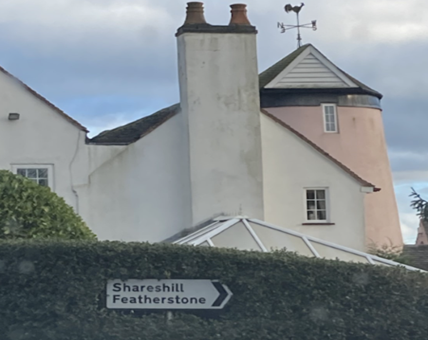
Figure 8 Village signposts when entering Shareshill Village
The Village:
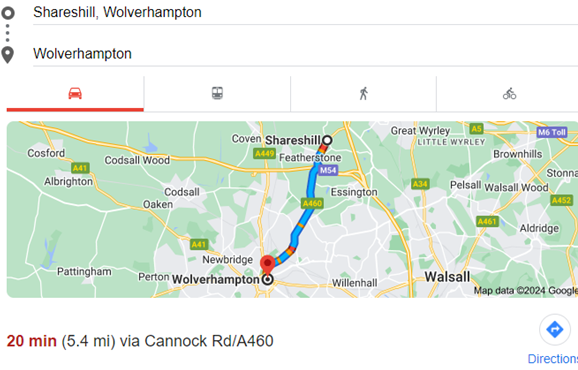
Shareshill is located “5.4 miles from Wolverhampton City centre” The Automobile Association (2024) reports, it is connected to the city by the A460 road and by a public transport bus service. It is close to both the M6 and M54 motorways.
Figure 9 Shareshill to Wolverhampton City Centre.
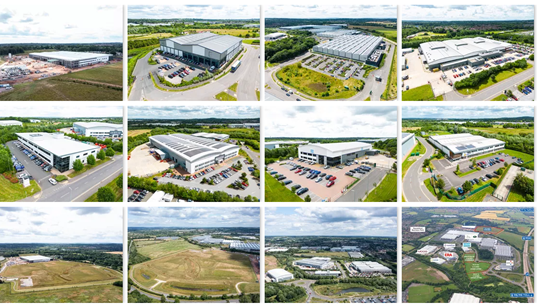
Shareshill also sits within 4 miles of the major Enterprise Zone, the i54, which promotes and describes itself as “A 300-acre, high profile site with an international reputation with some 2,700 people employed across the current businesses”. I54.com (2023)
Figure 10 The i54 Enterprise Zone:
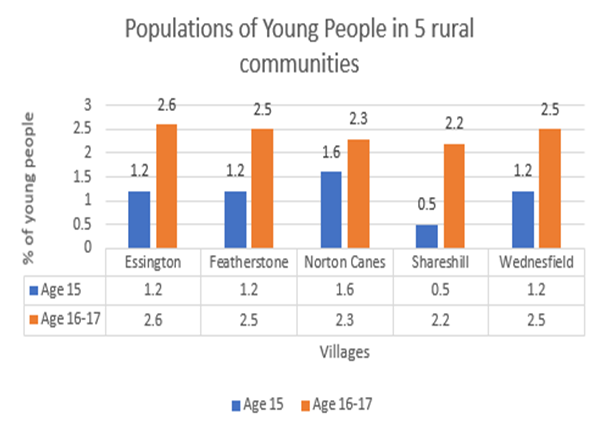
The population of Shareshill has 759 residents (Nomis 2024) within this community the demographics seem nearly equally split between males and females and with a lower-than-average number of children and young people when comparing Shareshill to other rural/village settings (see Figure 17)
Figure 11 Population of Shareshill in 2024
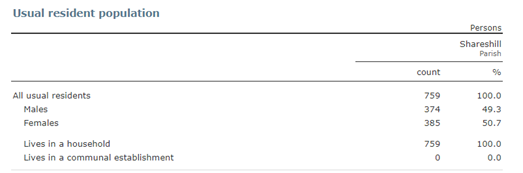
Figure 12 Breakdown of accommodation types in shareshill in 2024
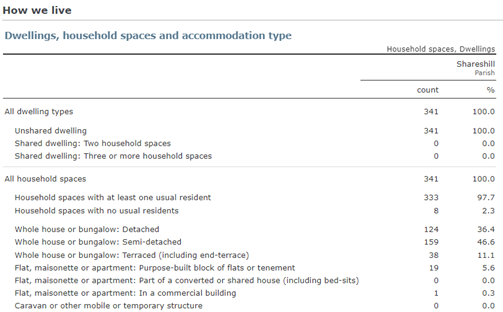
Figure 13 Housing in Shareshill
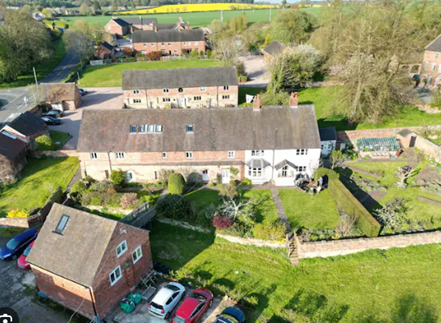
Figure 14 Breakdown of 15, 16, 17-year-olds in Shareshill
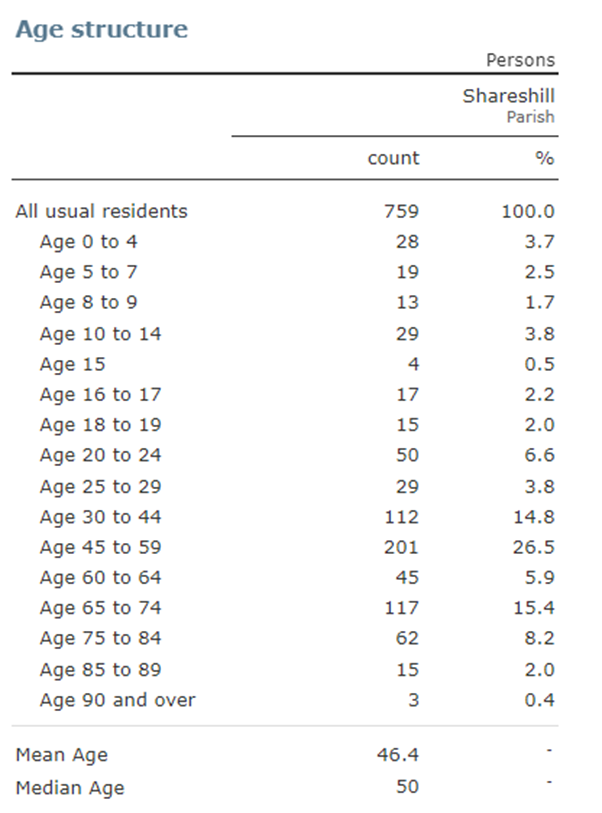
Figure 15 The ethnic breakdown of Shareshill residents
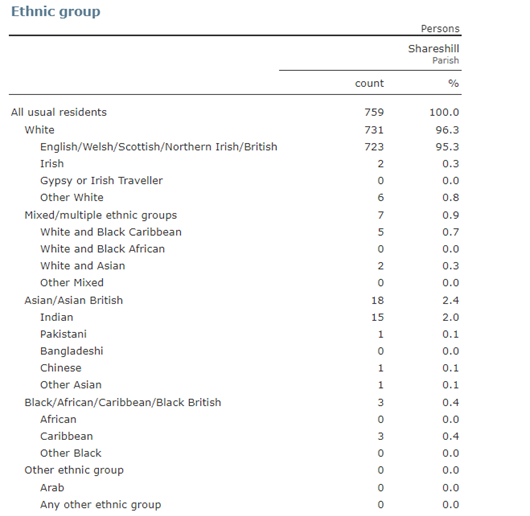
Figure 16: Occupations of the residents of Shareshill
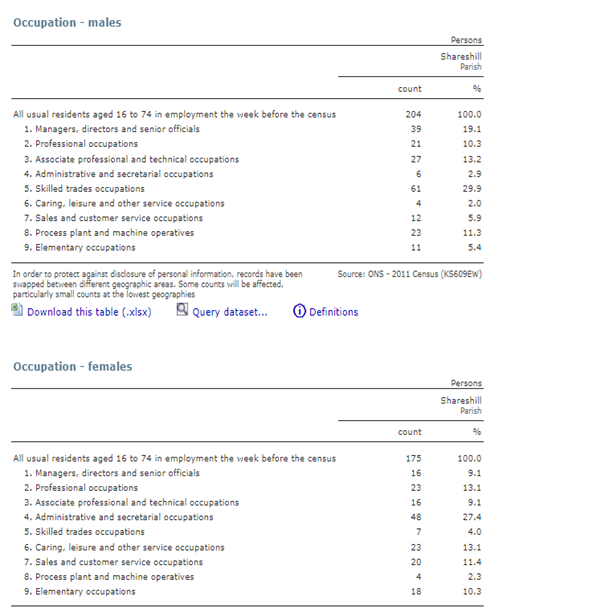
From the research data Nomis has provided added to the field notes, photographs of the village and lived experiences I hold from residing in the village Shareshill can be classified as:
- Rural/Sparse setting
- Predominantly white residential neighbourhood
- Traditional residential buildings/very few flats or shared housing.
- Adults largely working in skilled professionals.
- An affluent commuter town serving the cities in close commuting distance.
Young People facing social exclusion:
The Childrens and Young Persons Act (1933) and updated within the Leligastion.gov.uk (2013) define a young person as:
“A person who has attained the age of 14 and is under the age of 18”
To be able to clearly explore the issue of social exclusion of young people for the basis of this case study will be focusing on young people aged between the ages of 15-17 years because the Nomis data, see figure 14, for 14- and 18-year-olds includes other age ranges, therefore, to offer clarity within this case study will look at the specific 15-17 age range only.
Social Exclusion is the process in which individuals are blocked or denied full access to opportunities and resources that are wildly available to their peers, HM Gov (2015) define this as:
“Social exclusion has been defined by the UK’s Department for International Development (DFID) as ‘a process by which certain groups are systematically disadvantaged because they are discriminated against on the basis of their ethnicity, race, religion, sexual orientation, caste, descent, gender, age, disability, HIV status, migrant status or where they live”
Daniel & Ivetts (1998 p18) discuss this further by stating social exclusion must:
“Recognise the right of a person to sufficient resources and social assistance to live in a manner compatible with human dignity as part of a comprehensive drive to combat social exclusion”
The Rowntree Foundation (2000) reported with regards to the impact of young people being socially excluded a key factor was:
“The local area was a key influence on young people, the viability of a job, college course, training placement or health service provision was largely dependent on its physical proximity to the neighbourhood”
When we consider the access to these areas it is apparent young people in Shareshill have little or no access to these key indicators, as this case study will clearly highlight, this is discussed by Ridge. T (2002 p 55) who stated:
“Rural areas tended to be characterised by a paucity of public transport provision which was likely to be expensive and poorly targeted at the needs of children young people”
As Figure 14 reflects there are 21 young people living in Shareshill currently making 2.7% of the population of the village, a relatively small figure, when we compare this with other rural communities, we can see that Shareshill has the lowest proportion of young people across five similar settings.
Figure 17: Population of young people in 5 rural communities:
Social Exclusion – Education:
Childrens education provision has altered dramatically in the last two decades through neo-liberal policies New Labour introduced from 1997 onwards and have been pursued by successive Governments to reform the education sector, thereby freeing up schools to become not the historical public good serving societal needs but offering opportunities for parents (consumers) to select alternative education provision and choice along a market-based principle, writing in The Guadian W, Monbiot, G (2016) describes:
“Neoliberalism sees competition as the defining characteristic of human relations. It redefines citizens as consumers, whose democratic choices are best exercised by buying and selling, a process that rewards merit and punishes inefficiency. It maintains that “the market” delivers benefits that could never be achieved by planning.”
New Labour introduced its academies program to improve education standards “particularly in disadvantaged communities and areas of poor educational performance” UK Parliament (2015) thereby allowing parents a greater and wider choice of education settings to select from, if they felt the local school was not preforming sufficiently.
In Shareshill there is only one education setting for children aged 4-11 years old, it is a small primary setting with 160 pupils on roll, Ofsted (2021) describe it as “smaller than the average sized primary school” there are no other education settings for children and none for young people this report focuses on, this clearly reflects that due to the lack of investment in education settings for young people in rural communities they are more likely to being excluded from accessing outstanding education provision based on their location.
Figure 18 The sole education setting in Sharesill:

Academies were introduced under the 1997–2010 Labour Government, through the Learning and Skills Act (2000) which allowed schools to leave local education authority and become self-governing around budgets, staffing and to a lesser degree delivery of the curriculum, over the last two decades following this neo-liberal opening of the education industry multi educational trusts like the one Havergal Primary Academy operates within have taken greater control over parents choices of their child’s education provision and disenfranchised parents, Adams, R (2022) writing in The Guardian reports:
“Three decades of school choice has left parents feeling more cynical, fatalistic and disempowered calling the system of choice an illusion”
An 11-year-old child living in the village departing their primary school education from the Havergal Primary Academy who will have experienced their school life based around a rural setting, (see figures 17-18) with small class sizes and small friendship groups will be signposted to the local Trust secondary school which has over 1300 students on roll and is a large bustling secondary school in an urban environment.
This dramatic change from a rural education setting where close friendships are formed is as Ridge, T (2002 p63) highlights the importance of friendships and the value of developing social relationships play a significant factor in the development of young people as she states:
“Children and young people in rural areas indicated they felt vulnerable particularly with regards to bullying”.
In part due to young people’s unique primary education experience in a rural community which was noticeably different when they re-located to secondary education, with friends from a smaller friendship pool to trust and rely on for support and with less common experiences to form new friendship groups, young people from the village struggled with this transition leading to their social exclusion.
Figure 19 Screenshot from the Havergal Primary Academy website
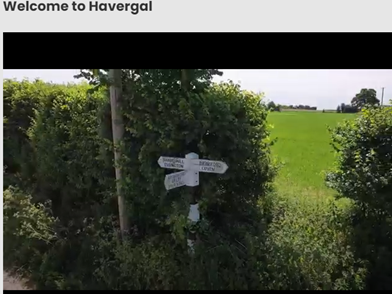
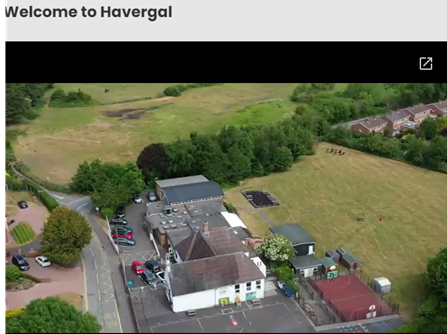
Figure 20 Screenshot from the Havergal Primary Academy website
Social Exclusion – Employment and Public transport:
Shareshill has limited employment opportunities for young people in the village, there is a community shop/post office and a public house but both these by their nature discount any meaningful chance of employment.
The village shop is staffed by volunteers and run as a community enterprise; it purpose is not to create a profit but to offer a necessary service to community. The Post Office handles complex financial transactions and would only be suitable for an experienced and highly trained member of staff, and finally the public house sells products that young people are legally not allowed to work with, therefore without opportunity to work within the local community young people are excluded from employment in the village they live in.
Figure 21 Employment opportunities in Shareshill:
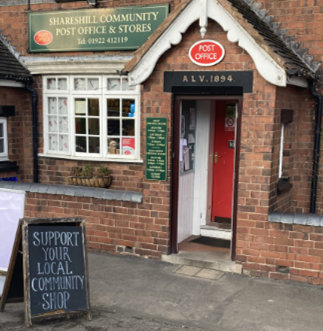
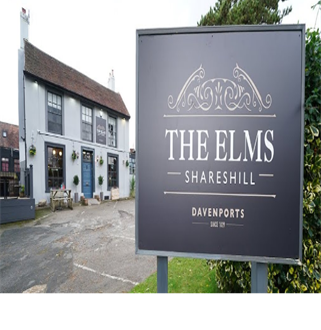
Therefore, to access employment opportunities in the nearby city centre young people would need to utilise public transport from the village.
Public transport much like the education industry been subject to successive Government neo-liberal policies whereby the existing market which was funded and delivered by the Government through taxation has been privatised through the Transport Act (1980), which as Butcher, L (2010) reported to Parliament would address:
“The gradual decline in rural bus services reflects the general pattern and is not demonstrably a consequence of deregulation. Deregulation has provided opportunities for operators to experiment with new services. It is arguable that some of those which have been tried in the more rural areas would not have been allowed without the licensing system”.
Public transport to Shareshill is delivered through one of these bus franchise licensing systems, now operated by Chaserider, which is the most recent franchisee to operate this rural public transport route, Vukmirovic, J (2023) writing in the regional Express & Star newspaper reported that Chaserider promote the service as:
“Here at Chaserider, we have a great range of multi-journey saver tickets making bus travel a viable alternative to using the car for many journeys”
With the cost-of-living crisis making car ownership more difficult for young people to achieve, a frequent, reliable public transport service is vital to support access wider employment opportunities, and Government neo-liberal policies around transport are designed to support people into work through access to public transport networks, Ridge, T (2002 p11) describes “current political rhetoric and policy is directed towards a notion of social exclusion that is primarily concerned with the exclusion from the labour market”
Figure 22 Public Transport in Shareshill
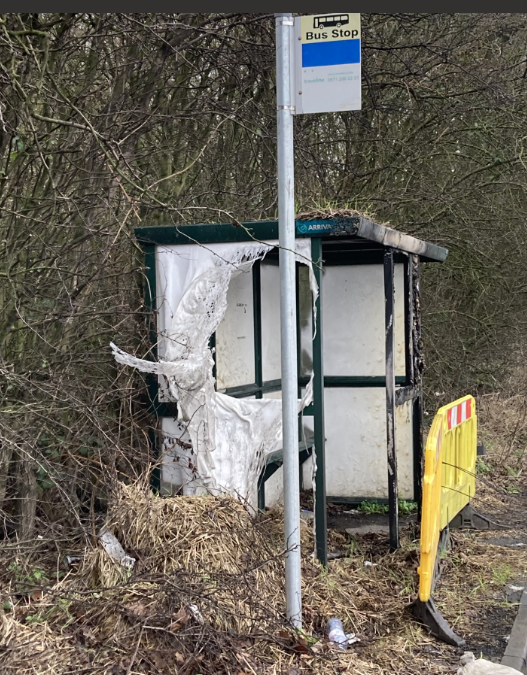
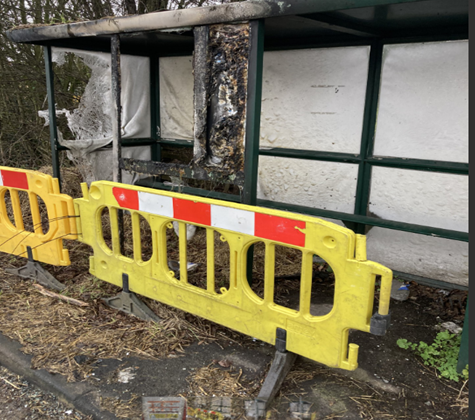
Figure 23 Chaserider Bus Timetable for village
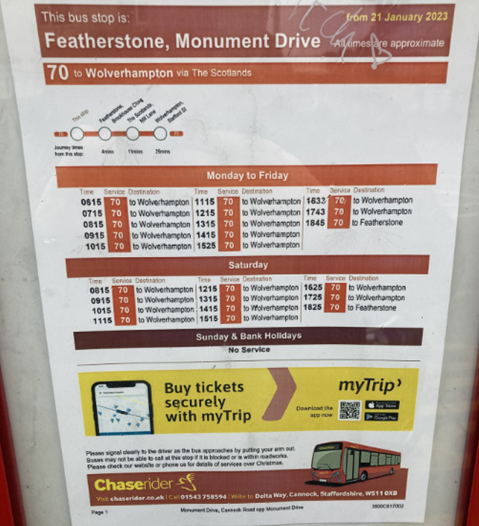
The primary research this reported has investigated reflects that young people will be largely excluded from employment in the city centre if they do rely on public transport due to an appalling lack of provision, secondary research also bears this out Tripadvisor (2023) whereby reviews such as:
“buses either turn up Late or don’t bother turning up at all”
Primary Research #3 – Ashley (name changed)
“ The bus service is appalling, you cant rely on it at all, with the service being once an hour during the week and finishing before 7pm to get home from my job at McDonalds Mum or Dad have to collect me, if they couldn’t do this, I couldn’t work – if shows how isolated we are”.
This lack of a reliable public transport service reflects young people in Shareshill are being directly socially excluded from employment opportunities and denied access to resources to facilitate work that other young people in urban areas are not, this is as Daniel & Ivetts (1998 p18) states:
“To recognise the right of a person to sufficient resources and social assistance to live in a manner compatible with human dignity as part of a comprehensive drive to combat social exclusion”.
This erosion of a key public service through neo-liberal policies is illustrated by BBC News (2023) which highlights “Axing bus routes in England leaves communities “cut off” from essential services and interactions” and is followed up by Khawaja, B (2021) writing in The Guardian who reports:
“bus privatisation has destroyed a British public service – but there is a way back, the UK and devolved governments should abandon the notion that public transport can be left to the private market”
Social Exclusion – Housing:
Housing is a further example of a previous public good being largely transferred into a private ownership through Neo-liberal Government policies, this commenced in 1980 under the Conservative Government led by Maragret Thatcher who introduced the policy known as “Right to Buy” which was a policy to sell off the country’s social housing stock and not re-invest in building and replacing these properties. Portlock, J (2020) writing in The Guardian highlighted:
“Margaret Thatcher’s ‘right to buy’ removed thousands of council houses from the rented sector, and her policy denying local authorities the right to use money from the sales to build new houses began the present social housing shortage”.
With Shareshill being a small rural village, housing is a scare resource with greater demand for housing then is currently available, where new build housing has occurred in the village this has been large family sized properties aimed at private ownership, house prices in the village are above national average as reflected by housing advertised for sale by local estate agents Webbs (2024), with the average property in Birmingham priced at £231,489 as reported by Statista (2023)
Figure 24 Housing in Shareshill

Social Housing in the village is extremely limited, UK Social Housing (2024) a leading UK based database report there are only 35 social housing properties within the village out of 341 total properties reflecting 89.7% of the homes are privately owned, when comparing this to Featherstone the nearest urban setting, this has 1754 social housing properties reflecting private ownership drops to 54%.
Figure 25 Social Housing in Shareshill/Featherstone
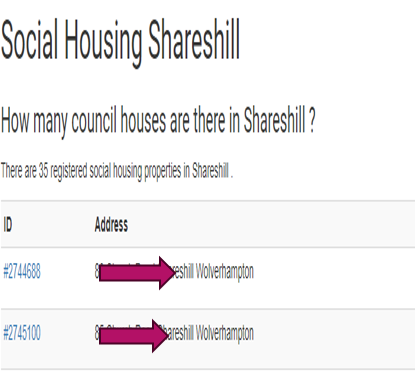
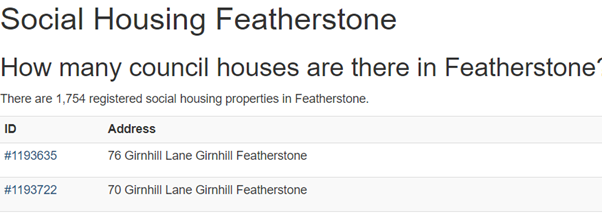
This lack of social housing and the increasing costs of private ownership in the village again leads to young people being socially excluded from remaining in their community.
Recommendations:
- Improved Public Transport Networks:
Young People in rural communities must have greater access to the resources required to allow them to fully participate in the economy/society as their location automatically puts them at a disadvantage without a regular and reliable public transport network. Ridge, T (2002 p55) reflects this when she states:
“For rural children the issue of finding work was particularly problematic, if they live in a small village where there are no opportunities for work”.
With many young people needing public transport to access employment in the nearby city centre, central Government and regional policy makers must allocate sufficient funds from any regional transport budgets to support greater access to improved public transport in rural areas, Gov.UK (2023) called for “Future of Transport – rural strategy” consultation to consider:
“New transport innovations that are inclusive and practical for all who live in our villages, towns, and more isolated locations.
Innovation and funds from the South Staffordshire rural transport programme (SSRTP) should be directed to reallocate the existing council’s fleet of buses and coaches to offer a broader, efficient and flexible transport service for rural communities. The SSRTP are currently considering within a report staffordshire.moderngov.co.uk (2023):
“To work jointly with South Staffordshire District Council to implement integrated transport structures to support the needs of rural communities, the transport arrangements continue to be provided in a traditional way, which is both an inefficient and ineffective use of the existing transport fleet.
By decommissioning the existing fleet, it is possible to provide a more flexible transport facility that not only meets existing service users, but also addresses the requirements of the District Council, and the wider rural community. The revised outsourced service will offer a greater flexibility of options to residents of South Staffordshire who are affected by rural isolation in their daily lives”.
By allocating greater resources to the provision of public transport for rural communities this should offer families the opportunity to access alternative education provision that is currently not available to them giving them greater freedom of choice over their education preferences.
Furthermore, young people in Shareshill will have the opportunity to access employment from within Wolverhampton city centre and the nearby i54 enterprise zones should the revised public transport network recommended offer a broader coverage then the current bus provider operator offers.
Recommendations:
- Increased affordable rural housing:
Young People in rural communities must have greater opportunity to live in the community they grew up within, by connecting rural villages through improved public transport links offering greater levels of employment, young people should have the economic means to reside in their community if more affordable housing schemes are delivered.
Action with Communities in Rural England (ACRE) a community group representing rural communities highlight the pressures:
“Living in rural areas has its challenges. Rural communities often lack basic services, homes that people can afford and employment opportunities – problems made worse by poor connectivity to other areas”. (ACRE, 2024)
Therefore, this and successive Government’s must place greater priority in a long-term strategy to address and increase affordable housing through existing policies such as the Rural exception policy, GOV.UK (2021) which states:
“Allow local authorities to grant planning permission for affordable housing on land that would not normally be used for housing”.
An example reflecting how this would support young people remaining in their communities is The East Cambridgeshire District Council (2020) when they devised such a plan to support community-led homes by stating:
“This gives community-led housing groups an advantage in approaching landowners over traditional developers, who are not usually permitted to develop on the land”.
Affordable housing schemes such as the one devised by ECDC must have an allocation of housing set aside for young people to address their social exclusion from their local community, thereby addressing and offering young people the access to materials to be social included within their community/society.
 PJR Education Consultancy
Leave a comment